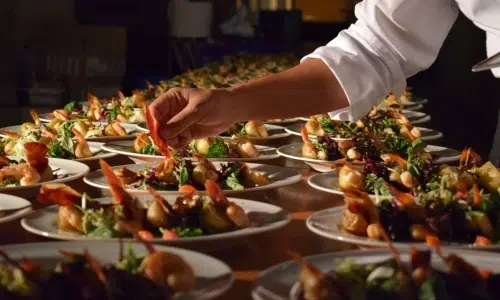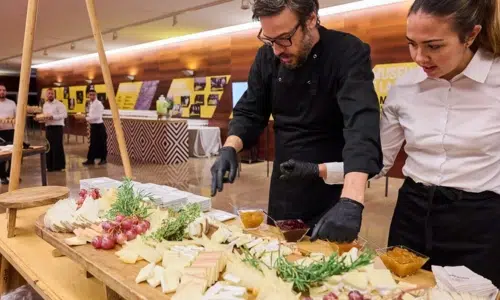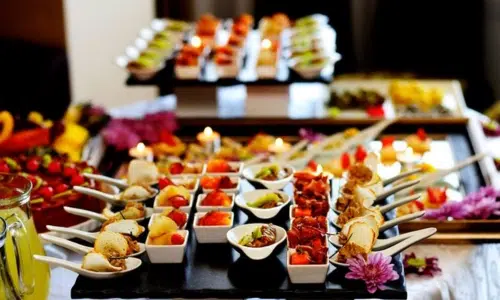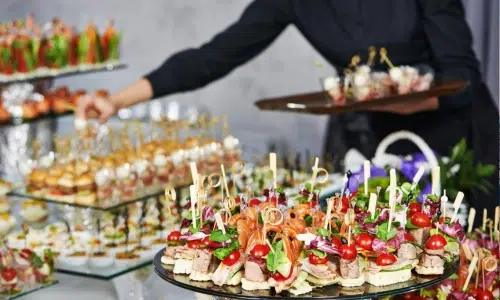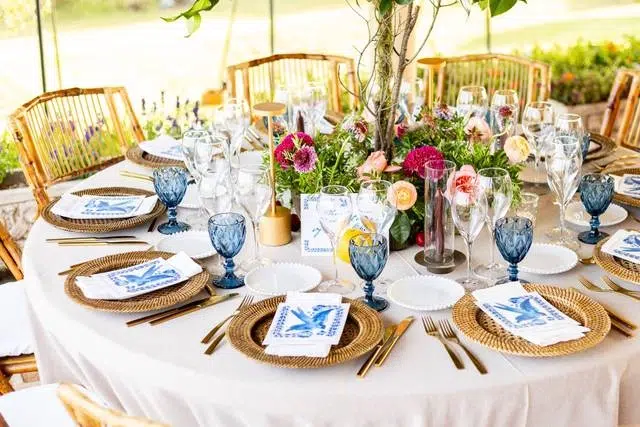
Catering is the biggest line on almost every wedding budget after the venue, and it’s the thing guests remember longest. It’s also where the most money gets wasted, usually on a menu that photographs well and doesn’t suit the day.
What we actually do. We match you with caterers who suit your venue, your numbers and the kind of day you want, then handle the tasting, the menu and the negotiation. Some venues insist on their own kitchen or a short approved list, so the first thing worth establishing is whether you have a choice at all. On a dry-hire villa or finca you usually do.
What it costs. Expect €75 to €150 per person on the Costa del Sol, more in Barcelona and the islands, depending on the format and the drinks package. The variables that move it most are the number of courses, whether the bar is open or limited, and how long you want service to run. Always confirm whether a quote includes IVA at 21%, because some do and some don’t.
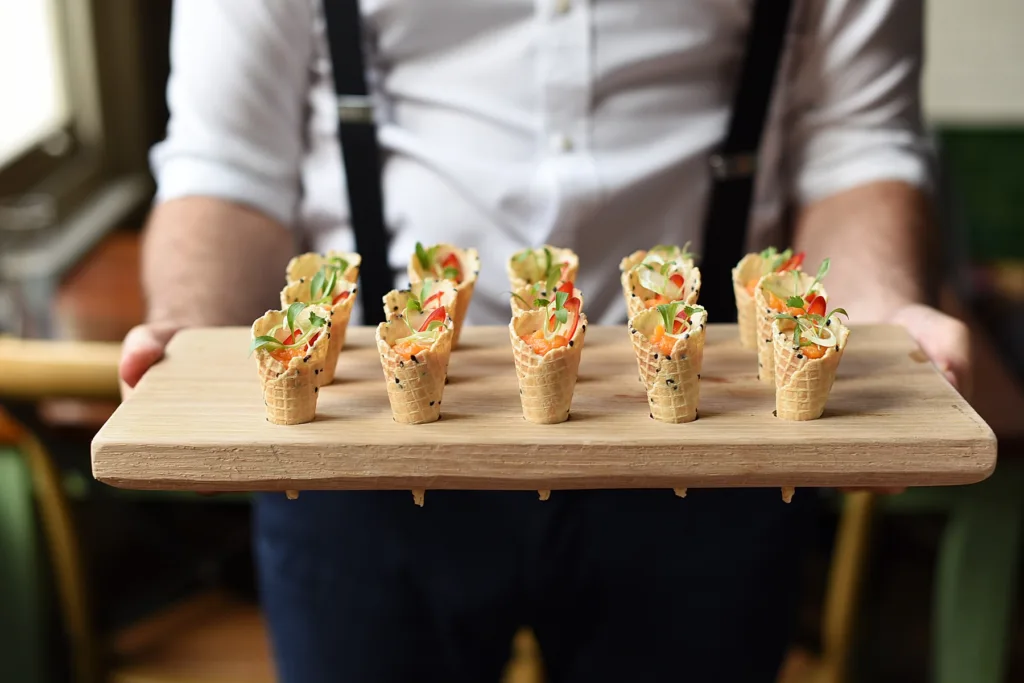
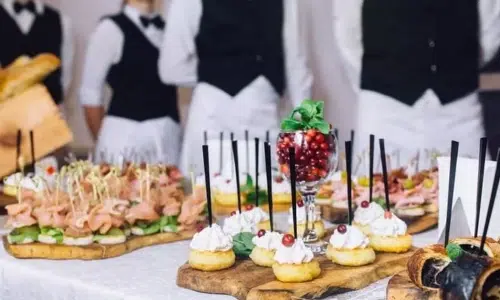
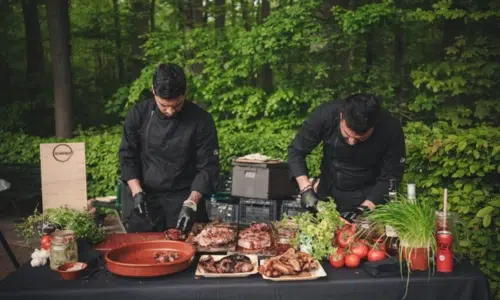
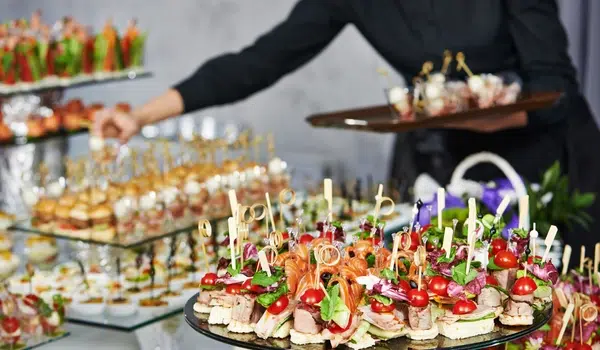
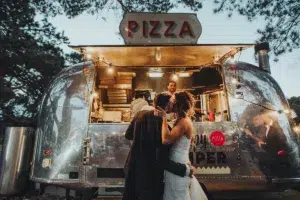
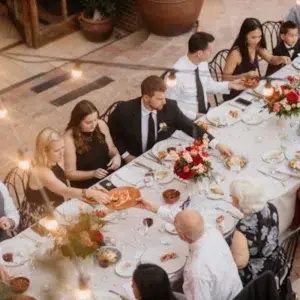
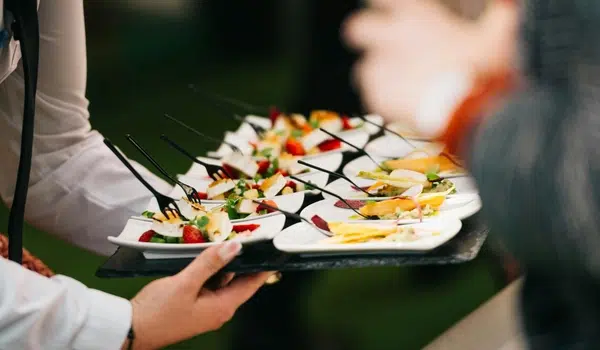
Formats worth knowing about. A seated banquet is the most formal and the most staff-intensive. Sharing plates and family-style service tend to loosen a room up and cost less to serve. Live stations, whether that’s a paella pan, a carvery or a grill, work well for a relaxed afternoon and give guests something to gather around. Most Spanish weddings run a long canapé reception before dinner, often an hour and a half, which is longer than British couples expect and worth planning for.
Private chefs. Separate from the wedding catering, and mostly used for the days either side. A chef at your villa for the welcome dinner or the day-after lunch costs a fraction of a restaurant booking for the same group, and it keeps everyone in one place. Worth arranging if you have family staying on site.
Two things to get right. Get dietary requirements to the caterer early rather than on the day, since Spanish kitchens will accommodate almost anything with notice and very little without it. And ask what happens to the timings if it rains, because moving 100 covers indoors changes the service plan and it’s better agreed in advance.
What we check that you wouldn’t think to.
Whether the venue’s kitchen can actually take the numbers. At rural fincas it’s often domestic rather than commercial, which means mobile refrigeration, extra prep space and sometimes a generator appearing on the caterer’s invoice rather than the venue’s. That’s the gap between a €3,000 venue and a €3,000 venue that costs €6,000.
Whether the staffing covers the whole night or stops at a set hour. Service is charged by time, not by course, and a wedding that runs to two in the morning costs more to staff than one finishing at midnight. Find out which you’re buying.
Whether you can bring your own wine, and what the corkage is. On a hundred guests this is frequently the single largest saving available, and plenty of caterers will allow it if asked.
Why we’re worth having in the room.
We take no commission from any caterer, so a recommendation costs us nothing either way. That matters more here than almost anywhere else in a wedding budget, because catering is the line where a supplier has the most room to quote high and where a couple has the least ability to judge whether a price is fair.
What we bring is knowing what things should cost, spotting what’s been left out of a quote, and knowing which caterers turn up with what they promised. Anyone can find twenty caterers on the Costa del Sol. Knowing which three suit your venue and your numbers is a different job.
Where to spend and where not to.
Spend on the canapé reception, because it’s ninety minutes long and it’s the first food anyone tastes. Spend on the wine, since a decent Rueda costs very little more than a poor one. Spend on staffing if you’re doing a plated dinner, because slow service ruins a good menu.
Save by shortening the reception rather than cutting courses. Save by serving family-style rather than plated, which cuts staff numbers significantly and warms a room up. Save by going midweek, since caterers protect their Saturdays the same way venues do.
What happens next. Tell us your venue, your numbers and roughly what you’re picturing, and we’ll come back with two or three caterers who genuinely fit, along with what each will realistically cost.
Get in touch or see our wedding packages if you’d rather have catering bundled with the venue, styling and coordination at a fixed price.
Catering is the largest line on almost every wedding budget after the venue, and unlike venue hire it scales directly with your guest list. Every extra head is another cover, another chair, another share of the bar.
Roughly what to expect per person:
| Format | Costa del Sol | Barcelona & islands |
|---|---|---|
| Canapé reception only | €25–€45 | €35–€55 |
| Buffet or family-style | €60–€90 | €75–€110 |
| Three-course plated dinner | €75–€120 | €90–€150 |
| Premium plated with pairings | €120–€180+ | €150–€220+ |
Drinks are usually separate, and this is where budgets slip. A limited bar with wine, beer and soft drinks through dinner might add €20 to €35 a head. An open bar running to 2am can double that. Ask exactly what “drinks included” covers and until what time, because the two rarely mean the same thing at two different venues.
Four things that move the number more than the menu does.
Service length. A wedding that runs from a 5pm ceremony to 2am costs materially more to staff than one finishing at midnight. Staffing is charged by the hour, not by the course.
The canapé reception. Spanish weddings typically run 90 minutes of canapés and drinks before dinner, longer than British couples expect. That’s a meal’s worth of food and a lot of bar service before anyone sits down.
Whether the venue has a kitchen. Dry-hire fincas often don’t, or have one too small for the numbers. Bringing in mobile kitchen equipment, refrigeration and sometimes a generator is a real cost that appears on the caterer’s quote rather than the venue’s.
IVA at 21%. Some caterers quote inclusive, some exclusive. On €10,000 of catering that’s €2,100. Ask before comparing two quotes.
Where to save without anyone noticing. Shorten the canapé reception rather than cutting courses. Choose a limited bar with good wine over an open bar with mediocre spirits. Serve family-style rather than plated, which cuts staffing significantly and tends to make the room warmer anyway. And go midweek, since caterers have the same Saturday problem venues do.
Where not to save. On a small wedding, everything is under closer inspection and the food is what people remember. If there’s one line worth protecting, it’s this one.
The format you choose shapes the day more than the menu does. It sets the pace, decides how much of the budget goes on staff rather than food, and largely determines whether people stay in their seats or move around.
Canapé reception. Not a format on its own, but worth understanding because it’s where Spanish and British weddings differ most. Here the drinks reception runs long, often ninety minutes, with substantial passed canapés and stations. It’s closer to a first course than a bowl of olives, and it’s why dinner doesn’t start until nine.
Plated dinner. The most formal option and the most staff-intensive, which is why it’s usually the most expensive. Three or four courses, everyone served at once, speeches slotted between. Suits a larger, more traditional wedding and gives the clearest structure to the evening. The trade-off is that people stay put, so the room can feel static until dancing starts.
Family-style sharing. Large plates brought to each table for guests to serve themselves. Cheaper to staff than plated, generous-feeling, and it does something to a room that plated service doesn’t: strangers on a table start talking because they’re passing each other the lamb. If you want warmth over formality, this is the one.
Buffet. The most flexible and usually the best value at scale. Guests choose what they want and go back for more, dietary requirements largely sort themselves out, and the kitchen isn’t timing 120 covers to the minute. The queue is the only real drawback, and a good caterer manages it with two service points rather than one.
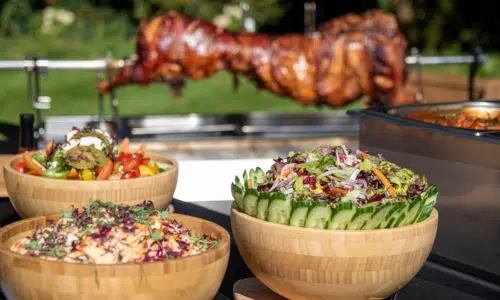
Food stations. A paella pan, a grill or parrillada, a carvery, a cheese table. Guests gather round, there’s something to watch, and it works particularly well for a relaxed afternoon or as the second act after a seated dinner. Popular at fincas, where there’s space to spread out.
Hog roast and asador. The outdoor grill, done properly. Suits inland venues and country estates far better than beach clubs, and it’s a genuine centrepiece rather than just a way of cooking meat.
Private chef. Separate from the wedding itself. A chef at your villa for the welcome dinner or the day-after lunch, cooking for ten or twenty rather than a hundred. Costs a fraction of booking a restaurant for the same group and keeps everyone in one place.
A private chef isn’t usually for the wedding day itself. It’s for the days either side, and it’s one of the better-value decisions couples make.
Where it earns its money. If you’ve taken a villa or a finca with rooms, you’ll have your closest family on site for two or three nights. Booking a restaurant for fourteen people the night before means transport both ways, a fixed sitting time, and everyone shouting down a long table in a room full of strangers. A chef comes to the house, cooks in the kitchen you’re already paying for, and people eat when they’re ready. For similar money you get a better evening.
The same applies to the day after. A slow lunch by the pool while everyone picks over the wedding tends to be the part people remember, and it costs very little to arrange.
What it costs. Expect around €50 to €90 per person for a well-executed multi-course dinner on the Costa del Sol, including the chef’s time and ingredients. Smaller groups cost more per head, since the chef’s day rate is spread across fewer people. More elaborate menus go higher.
Wine is normally separate, and you can supply your own. That’s where a chef beats a restaurant by a distance, because you’re paying shop prices rather than restaurant markup on every bottle.
For groups over about twelve you’ll usually need a server alongside the chef, which is quoted separately.
How it works. We start with a call to confirm numbers, dietary requirements and what the kitchen at your property can actually handle. That last point matters more than people expect, particularly at rural fincas where the kitchen may be domestic rather than commercial. The chef then arrives with everything needed, cooks, serves and clears. You do nothing.
Formats. A plated dinner suits a formal welcome. Tapas and sharing plates work better for a group who’ve just arrived and would rather talk than sit through four courses. A paella cooked outside doubles as entertainment and tends to be the one people photograph.
Worth knowing. Book the chef when you book the villa, not afterwards. The good ones are busy on the same Saturdays the venues are, and the night before your wedding is the night before a lot of other weddings too.
Mediterranean Starter: burrata with heritage tomatoes, basil oil, toasted pine nuts, and balsamic pearls, or a refined prawn and citrus salad with avocado and micro herbs. Main: oven-roasted sea bass or sea bream with saffron potatoes, seasonal greens, and a lemon-caper beurre blanc. Dessert: mango and passion fruit panna cotta, or a light lemon posset with berries and shortbread for a clean finish.
English Country: Starter: leek and potato soup with chive oil, or smoked salmon with dill crème fraîche, pickled cucumber, and rye crisp. Main: rosemary and garlic roast lamb rump or slow-braised lamb shoulder, served with dauphinoise potatoes, honey-glazed carrots, tenderstem broccoli, and a rich red wine jus, with mint sauce available on request. Dessert: sticky toffee pudding with warm toffee sauce and vanilla ice cream, or an Eton mess style dessert with fresh berries and meringue.
Asian Fusion: Starter: tuna tartare with soy, lime, sesame, and avocado, or crispy tempura prawns with a yuzu mayo dip and pickled cucumber. Main: miso-glazed black cod or teriyaki salmon with jasmine rice, stir-fried seasonal greens, and ginger-lime dressing, with an alternative of Korean-style short rib or soy-braised beef for guests who prefer meat. Dessert: coconut panna cotta with mango and lime, or matcha cheesecake with a berry compote for a light, elegant finish.
Indian Banquet: Starter: mixed veg pakoras with mint yoghurt, tandoori chicken skewers, and mini chaat cups with tamarind and yoghurt. Main: slow-cooked lamb rogan josh or butter chicken, paired with a paneer tikka masala or chana masala for vegetarian guests, served with saffron rice, naan, raita, and fresh salads. Dessert: gulab jamun with cardamom syrup, or mango kulfi with pistachio and rose for a classic, crowd-pleasing ending.
Vegetarian: Starter: grilled seasonal vegetables with romesco, toasted almonds, and basil, or whipped feta with roasted beetroot and citrus dressing. Main: wild mushroom risotto with parmesan crisp and truffle oil, or roasted aubergine with miso glaze, herbed couscous, and pomegranate. Dessert: dark chocolate torte with raspberry coulis, or a fruit-led sorbet trio for a lighter summer option.
The bar is the line most couples underestimate. It runs longer than the food, it scales with your guest list, and the difference between a limited bar and an open one on a wedding of 100 can be several thousand euros.
The first question is licensing. Many private villas and dry-hire fincas don’t hold their own alcohol licence, which means you can’t simply buy the drink and serve it yourselves. The solution is a licensed mobile bar service, which brings the licence, the stock, the equipment and the staff. Hotels and beach clubs have this covered; villas frequently don’t. Establish it before you plan anything else.
Then decide what “included” means. A limited bar with wine, beer and soft drinks through dinner typically adds €20 to €35 a head. An open bar with spirits running to 2am can double that. Neither is wrong, but a venue quoting “drinks included” and a caterer quoting “drinks included” rarely mean the same thing, so get it itemised.
A middle option worth knowing about is an open bar for the first two hours after dinner, then a limited bar. Most of the spirits get drunk early anyway, and the people still at the bar at 1am are usually happy with a beer.
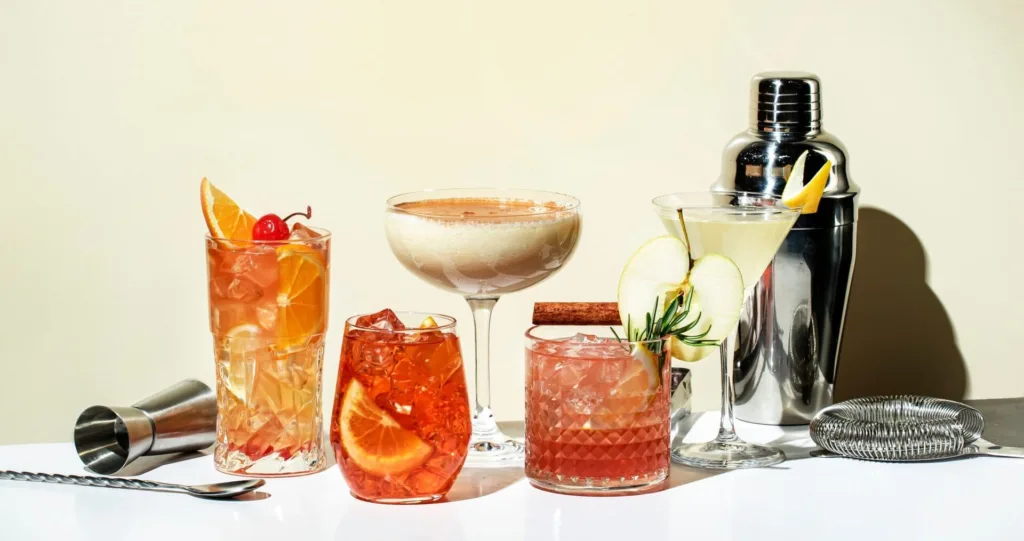
Cocktails. Aperol Spritz, Mojito, Margarita, Espresso Martini and Negroni cover almost every request. Pick three for a signature list rather than offering everything, because a bartender making five different cocktails for 100 people creates a queue nobody enjoys. Aperol Spritz is the reliable opener in this climate; the Espresso Martini earns its place later in the night.
Beer. Estrella Damm, San Miguel and Cruzcampo are the Spanish standards, with Cruzcampo the local choice in Andalucía. Peroni and a local craft lager give you range. Serve it properly cold, in bottles rather than plastic, and have more than you think you need in July.
Gin. Spain takes gin seriously, and a gin tonic here is served in a balloon glass with proper garnish rather than as an afterthought. Tanqueray, Hendrick’s, Martin Miller’s and Bombay Sapphire cover most tastes. Gin Mare is the one worth adding, since it’s Spanish, Mediterranean in character, and guests won’t have had it at home.
Brandy. Underrated by British guests and worth putting out anyway. Carlos I, Cardenal Mendoza, Lepanto and Torres 10. Spanish brandy is softer and sweeter than cognac, and it’s what your Spanish suppliers will drink at the end of the night.
Whisky. Johnnie Walker Black Label, Chivas Regal, Jameson and Glenfiddich 12 cover blended, Irish and single malt without stocking a full back bar.
Rum. Havana Club 7, Diplomático Reserva, Mount Gay Eclipse and Bacardí Reserva. Diplomático is the one that surprises people, and it does double duty in cocktails and as a sipping rum.

Not every gathering around a wedding is the wedding. The dinner the night before, the lunch the day after, the engagement party, the smaller celebration for people who couldn’t make the main event. These are easier to arrange than couples expect and they’re often where the best conversations happen.
The welcome dinner is the one we’d push hardest. Guests have flown in, they’re in a new place, and half of them don’t know each other. An informal dinner the night before does more for the atmosphere of the wedding itself than almost anything you could spend the same money on. At a villa with a chef it costs a fraction of booking a restaurant for the same group, and nobody needs a taxi.
The day-after lunch is the other one worth having. Slow, unstructured, by the pool or under a tree, with everyone comparing notes on the night before. The formalities are done, nobody’s nervous, and it’s the part people describe when they get home.
Engagement parties and pre-wedding gatherings work the same way, whether that’s a tapas evening for the families to meet or something more polished.
How it works. For groups staying at a villa or finca, a private chef is usually the answer: they come to the property, cook, serve and clear, and you set the timings. For larger numbers or off-site events we’ll arrange catering, staff and whatever’s needed at the venue.
Either way we handle the booking, the menu and the logistics alongside the wedding, so it’s one conversation rather than three.

The cake is cut late here. Often after midnight, once the dancing has started, and served alongside the late-night food rather than as dessert. That’s not a rule you have to follow, but if you want it cut earlier, say so, because your caterer and photographer will otherwise plan around the Spanish timing.
Heat is a real constraint. Traditional buttercream doesn’t survive a July afternoon on the Costa del Sol, and fondant sweats. Any decent local baker will steer you towards Swiss meringue buttercream, ganache or naked finishes with fresh fruit and flowers, all of which hold up. If a supplier isn’t raising this with you unprompted, that tells you something.
What couples usually choose. Two or three tiers is plenty for 100 guests, particularly if you’re also serving dessert at dinner. Anything larger tends to be for the photographs, and there’s no shame in a smaller cake with a dressed dessert table beside it.
Spanish alternatives worth considering. Tarta de Santiago, the Galician almond tart, travels well and suits an afternoon. Torrijas, a sort of caramelised French toast served with ice cream, are a proper Andalusian dessert and go down better than a third course of chocolate. Crema catalana if you’re marrying in Catalonia. A late-night churros and chocolate station is worth every euro at two in the morning.
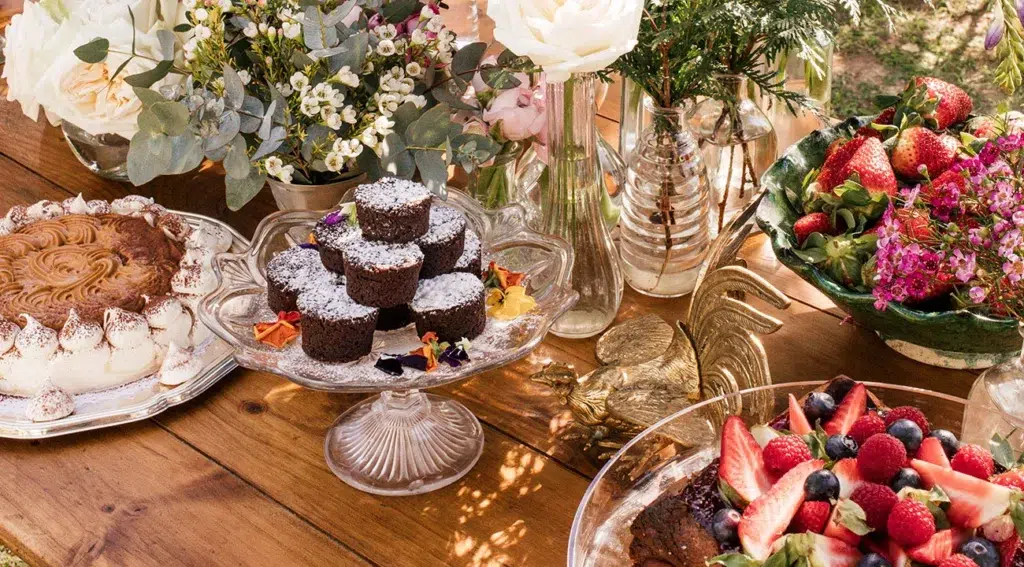
Dessert tables work well where the wedding runs long. A mix of small pastries, fruit, and something local gives guests a reason to get up between the dinner and the dancing, and it’s usually cheaper per head than a plated dessert.
Practical points. Confirm who supplies the cake stand and knife, since it’s frequently neither the baker nor the venue. Ask where the cake will be stored between delivery and cutting, because a marquee in August is not the answer. And name any allergies at the point of ordering rather than on the day.
This is home for us, and it’s the easiest place in Spain to eat well at a wedding. Marbella and Málaga between them support more caterers than anywhere outside Madrid, so you’ve got genuine choice rather than the three names everyone gets given.
The thing we’d tell you first is that the venue decides more than the menu does. Beach clubs and hotels along the coast have their own kitchens and usually insist you use them, which settles the food the day you book. Head twenty minutes inland to the fincas around Coín and Álora and it flips: you can choose whoever you like, but a lot of those estates have a domestic kitchen or none at all, so your caterer brings equipment, refrigeration and sometimes a generator. That’s usually what separates two quotes we’d otherwise call similar, and it’s the first thing we check for you.
Budget €75 to €150 a head for dinner, with Marbella at the top of that and inland Málaga noticeably below. Let the caterer build around the Málaga market seafood and the produce from the growers at Coín. They know what’s good this week and we’ve never regretted trusting them on it.
Couples who choose Barcelona usually care about food, and they’re right to. Catalonia has a proper culinary identity and the standard is high.
There’s one thing we’d want you to know before you fall for a venue, though. Most masies, the Catalan farmhouses where the majority of Barcelona weddings happen, come with a caterer attached, either one exclusive partner or a short approved list you can’t go outside. The kitchen and the venue are effectively the same booking. That’s not a bad deal, since the food is generally excellent and it makes the logistics much simpler, but it means your caterer is part of choosing the venue rather than a separate decision afterwards. We always ask this on your behalf before you get attached to somewhere.
Where you do have a free hand, at city venues and some Penedès estates, the supplier market is genuinely exciting and more adventurous than the coast. Reckon on €90 to €160 a head.
We’ll be straight with you: Ibiza costs more, and here’s why.
Almost everything arrives by boat. The produce, the wine, the equipment, often the staff, because the island’s population triples over the summer and the good people are booked months out. Expect to pay €100 to €180 a head for a menu that would cost €90 on the mainland, and expect suppliers to hold their prices between June and September, because they can.
The season is short too. Caterers here go flat out from May to early October and then stop. So if you’re flexible, a May or October date will get you better people for less money, and we’d push you towards it.
What you’re paying for is a supplier market that’s brilliant at exactly this: villa weddings, no kitchen, cooking outdoors, feeding a hundred people beautifully from a marquee. Not everyone can do that, and the ones here can.
Mallorca is the one where we’d encourage you to hand the menu over.
The finca wedding is what the island does best, and the food should follow the setting: long tables under the olive trees, sharing plates rather than plated courses, and a menu built from what the island actually grows. There’s a real food culture here that isn’t putting on a show for visitors. Sobrasada, ensaïmada, wines from Binissalem and Pla i Llevant that most of your guests won’t have tried. A caterer who’s given a free hand with that will produce something people remember far longer than another three courses of European hotel food.
Practically, most fincas are dry hire, so the caterer is yours to pick and the kitchen may be basic. Budget €85 to €150 a head. Book early for June to September, because the island’s supplier market is smaller than the Costa del Sol’s and the best ones fill their Saturdays a long way out.
Venue Sourcing & Tours | We expertly source and tour secure idyllic Andalucia wedding venues, from luxurious beachfront villas to rustic countryside fincas, perfectly tailored to your unique vision and style. See our hand selected Wedding Venues
Wedding Planning | Our professional Andalucia wedding planners meticulously handle every detail, from budgeting and guest logistics to design aesthetics, crafting personalised, stress-free celebrations. Also see our: Wedding Packages
On-Day Wedding Coordination | Our dedicated on-the-day wedding coordinators ensure your Andalucia celebration flows seamlessly by managing timelines, vendors, and guest arrangements, so you can enjoy your special day.
Vendor Sourcing & Management | Leveraging our trusted network of premium local suppliers, from top caterers and talented DJs to photographers and florists, we seamlessly manage all vendor interactions.
Before you move ahead with menu selections or dates, we encourage you to take a moment to explore our FAQs. You’ll find straightforward answers on everything from booking timelines and deposit terms to menu tastings, dietary accommodations, and coverage across Marbella, Sotogrande, and the wider Costa del Sol.
Reviewing this information up front will help you understand our processes, pricing structure, and sustainability practices, so your consultation can focus on crafting a truly bespoke experience. If something isn’t addressed, our coordination team is just a call or email away, and we’ll update the Frequently Asked Questions so future clients can benefit, too.
It depends on the venue type, and it’s the first thing we establish on your behalf.
Hotels, resorts and beach clubs almost always require in-house catering. The kitchen is part of the business model, and the venue fee is often low precisely because the catering margin carries it. You’ll typically see a minimum spend rather than a hire fee, commonly €10,000 to €25,000 depending on the property and the date.
Villas and dry-hire fincas generally allow any caterer, subject to approval. Expect the venue to ask for the caterer’s public liability insurance, usually a minimum of €600,000 to €1 million of cover, and evidence of food hygiene registration. Some charge a kitchen access fee, typically €300 to €800, and a few take a percentage of the catering spend.
Catalan masies frequently sit between the two, with one exclusive partner or an approved list of three or four. This is more common in Catalonia than anywhere else we work and catches couples out regularly.
If you already have a caterer in mind, tell us at the outset and we’ll filter venues accordingly. It costs nothing to do at the start and it’s expensive to unpick later.
Handled properly, and it needs to be flagged at booking rather than in the final fortnight.
Spanish food businesses operate under EU Regulation 1169/2011, which requires the fourteen major allergens to be declared. Any caterer we work with will produce an allergen matrix for your menu and share it with the venue.
The process we follow. Dietary requirements are collected with your RSVPs, consolidated into a single list, and passed to the kitchen at least three weeks out. The caterer confirms in writing which dishes are affected and how. On the day, affected covers are identified on the table plan and the service team is briefed, so the right plate reaches the right guest without anyone having to ask.
What good looks like. A parallel dish of equivalent quality rather than a plain alternative, separate preparation areas to prevent cross-contamination, and clear labelling on any buffet or station.
Expect a modest supplement for genuinely specialist requirements, typically €5 to €15 per affected cover, though most caterers absorb standard vegetarian, vegan and gluten-free requests within the quoted price.
Yes, and we recommend one before any contract is signed.
How they’re usually structured. Some caterers include a tasting for the couple within the proposal. Others charge a fee and credit it against the final invoice if you proceed. A minority charge outright. Standalone tastings on the Costa del Sol typically run €80 to €160 per person depending on the number of courses and whether wine is included.
What to use the session for. Flavour is the obvious part, but portion size, plating and pacing matter as much. Ask how long service takes for your guest count, because a menu that tastes excellent and arrives forty minutes late is still a problem. It’s also the moment to taste the vegetarian and dietary alternatives rather than assuming they’ll be equivalent.
Practical points. Bring anyone whose opinion will genuinely influence the decision, since additional guests are usually charged at the same per-head rate. If you can’t travel, several caterers will courier a sample box or run a video session, though it’s a poor substitute.
It varies more than couples expect, and we assess it during the venue visit rather than leaving it to be discovered later.
Full commercial kitchen. Hotels, resorts, beach clubs and larger event fincas. No additional equipment cost.
Partial or domestic kitchen. Common at villas and smaller fincas. Usable for finishing and plating but not for cooking at volume. Your caterer will bring supplementary refrigeration, holding equipment and prep tables.
No kitchen. Some rural estates and most outdoor sites. The caterer works entirely from a mobile setup.
What that costs. Mobile kitchen provision typically adds €800 to €2,500 depending on guest numbers and menu complexity. Generator hire, needed where power is limited, adds roughly €300 to €700. These appear on the caterer’s quote rather than the venue’s, which is why two venues quoted at €4,000 can differ by several thousand once catered.
The questions we ask on your behalf. Available power supply and phase, potable water access, refrigeration capacity, vehicle access for deliveries, distance from the prep area to the service area, and whether there’s shelter for the kitchen if it rains.
Yes, and for couples with guests staying on site it’s usually the best value decision in the whole budget.
The welcome dinner. A private chef at your villa costs substantially less than booking a restaurant for the same group once you account for transport both ways. Expect €50 to €90 per person including the chef’s time and ingredients, with wine supplied by you at shop prices rather than restaurant markup. For a party of fourteen, that’s frequently half what the equivalent restaurant evening would cost.
The day-after lunch. Simpler and cheaper, typically €35 to €60 per person for a relaxed spread. This tends to be the part guests describe when they get home, because the formalities are done and nobody is nervous.
Practical note. Book the chef when you book the villa rather than afterwards. The good ones are busy on the same Saturdays the venues are, and the night before your wedding is the night before a number of other weddings.
Halal is straightforward. There are established caterers on the Costa del Sol and in Barcelona working with certified halal suppliers, and halal meat is readily available across Andalucía. Be specific about the standard required, because there is a meaningful difference between halal-sourced meat prepared in a conventional kitchen and a fully halal kitchen with no cross-contamination. Both are achievable; they require different suppliers.
Kosher takes more organising. Spain’s kosher infrastructure is concentrated in Madrid, Barcelona and Marbella. A fully supervised kosher event generally requires a specialist caterer, imported or locally certified ingredients, and rabbinical supervision (mashgiach) present during preparation and service. Some venues will need to be kashered, which not every venue will permit.
Timeline. Halal, six to eight weeks’ notice is comfortable. Kosher, we’d want six months, and it should influence which venues you shortlist rather than being arranged afterwards.
Expect a premium of roughly 20% to 40% on standard catering for fully supervised kosher provision.
Yes. Our wedding packages include catering alongside venue sourcing, styling, suppliers and coordination at a fixed price, with packages starting from €11,800.
Catering typically represents the largest single component of a package, so the guest count drives the price more than any other variable.
If you’d rather arrange catering separately, we source and manage it as part of vendor sourcing at €100 for the first two suppliers and €25 for each thereafter. We take no commission from any caterer, so the recommendation is based on fit rather than fee.
Yes, staffing is included within every catering quote rather than charged separately.
Typical ratios. One server per eight to twelve guests for plated service. One per fifteen to twenty for buffet or sharing service, with additional staff positioned at stations for replenishment. Bar staff are allocated separately, usually one per fifty guests, with two at the peak immediately after dinner.
For weddings above roughly 120 guests, a service supervisor is standard, coordinating between the kitchen, the venue and your coordinator.
The question to ask. How many hours the quoted staffing covers. Service is charged by time rather than by course, so a quote covering the meal is not the same as one covering the night. Extending service from midnight to 2am on a wedding of 100 commonly adds €600 to €1,200. It’s the most frequent gap between a quote and a final invoice.
Standard provision covers cava, white and red wine, beer, soft drinks and water, served on arrival or immediately after the ceremony. Budget €6 to €12 per guest for a straightforward welcome drink.
Signature cocktails are increasingly common. Expect €8 to €15 per cocktail, or €30 to €50 per guest for a set cocktail period. We’d suggest choosing two or three rather than offering an open list, because a bartender producing five different drinks for a hundred guests creates a queue nobody enjoys. Aperol Spritz works well as an opener in this climate; Espresso Martinis earn their place later in the evening.
Alcohol-free options should be properly made rather than orange juice. Good bars here do alcohol-free spritzes and infusions well, and roughly one in ten of your guests will appreciate it.
One thing to establish early. Many private villas do not hold their own alcohol licence, which means you cannot simply buy the drink and serve it yourselves. The solution is a licensed mobile bar service, which brings the licence, stock, equipment and staff. Hotels and beach clubs have this covered. Villas frequently do not.
Yes, and both work well here for specific reasons.
Ice cream carts are worth their money at a summer wedding, particularly during the long afternoon gap between ceremony and dinner when guests are warm and waiting. Expect €400 to €900 for a two to three hour service depending on guest numbers, usually including an attendant.
Sweet carts and dessert stations typically run €5 to €12 per guest.
Churros and chocolate at one or two in the morning is the one we’d recommend above the others. It’s genuinely Spanish, it works precisely when people need it, and it costs less than most late-night options at roughly €6 to €10 per guest.
Yes, and Spain has a real advantage here.
Jamón ibérico carved to order by a professional cortador is a centrepiece rather than a plate of cold cuts. A whole leg serves roughly 60 to 80 guests as part of a wider spread, and a cortador for the reception typically costs €350 to €700 including the ham, depending on grade. Bellota is the top grade and worth the difference.
Spanish cheeses are excellent and underused at weddings here. Manchego at varying ages, Idiazábal from the Basque Country, Cabrales and Valdeón among the blues, and Torta del Casar, which is served with a spoon rather than a knife. Most British guests won’t have had any of them.
Grazing tables combining both, with membrillo, almonds, olives, tomato bread and local honey, typically run €12 to €22 per guest. They work well during the drinks reception or as late-night food, and they’re usually cheaper per head than a plated equivalent.