Wedding Florist Marbella
Creative Floral Designers in Spain & Gibraltar
Flowers are the biggest visual decision you’ll make about your wedding, and the one couples know least about when they start.
The thing worth knowing first about Spain is that most wedding flowers here are imported. Peonies, hydrangeas, garden roses, the blooms couples arrive wanting, largely come in from Holland, Ecuador and Kenya, straight into a cold store. That’s why “local seasonal flowers” is often a line rather than a fact, and why a bouquet in Marbella can cost more than the same one at home.
The second thing is heat. A hydrangea will wilt in an hour on an August afternoon and a pale rose browns at the edges by the speeches. A florist who works this coast plans around it, using varieties that hold, keeping arrangements out of direct sun until the last moment, and hydrating everything properly. One who doesn’t produces flowers that photograph beautifully at four and look tired at eight.
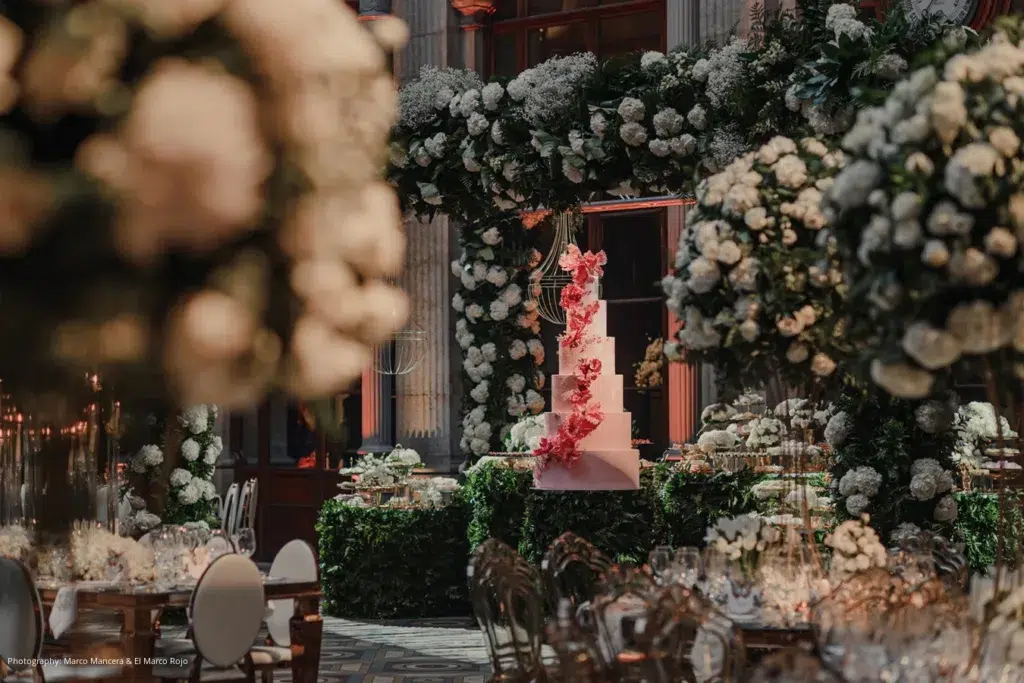
What good floral design actually does is give the day coherence. The same three or four colours repeated from the ceremony through to the tables. One substantial piece rather than a dozen small ones. A meadow along the aisle instead of arrangements scattered where nobody looks. It’s about placement and restraint rather than volume, and it’s the difference between a venue that’s been decorated and one that’s been designed.
And most of it can be moved.
Trusted Professional Wedding Florist Throughout Spain
Contact Us
Make Your Day Special with Us
Start Your Wedding Journey and discover our exceptional services, designed to make your day extraordinary and unforgettable. We look forward to creating wonderful memories with you.
Our Parners Work
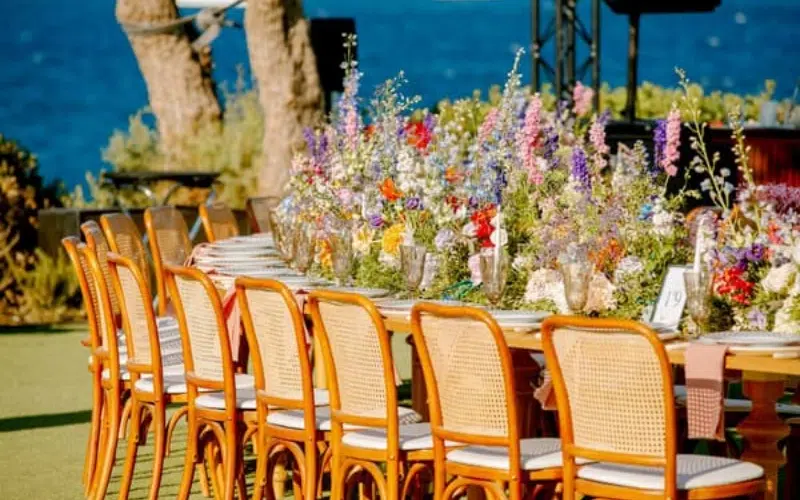
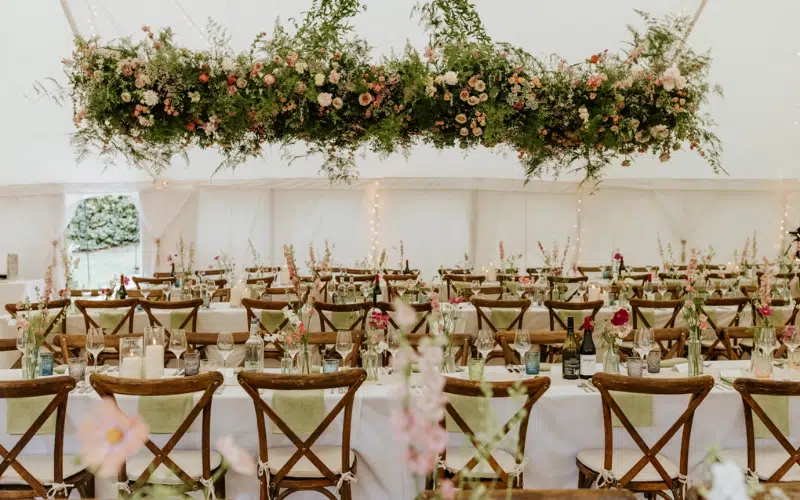
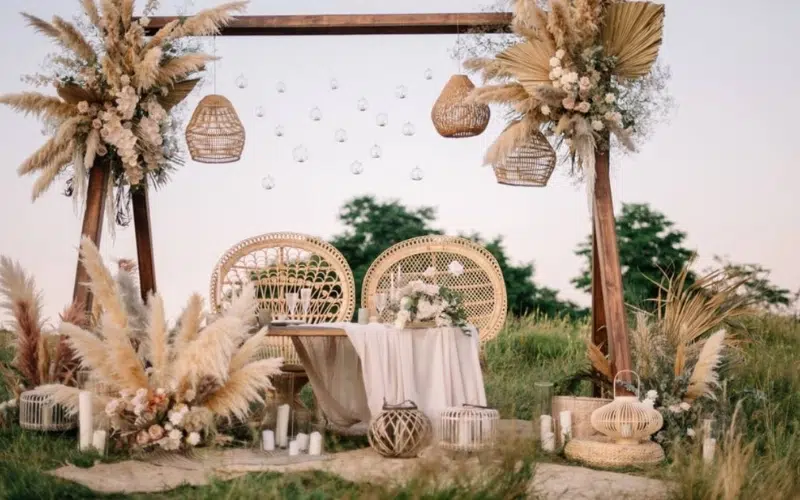
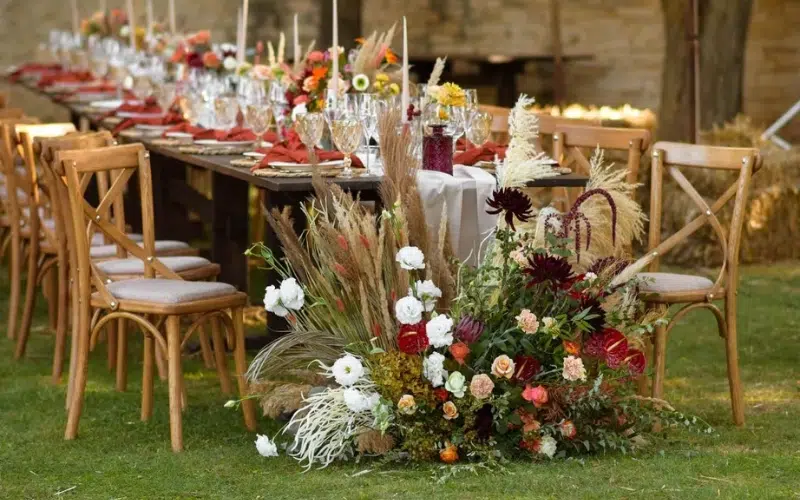
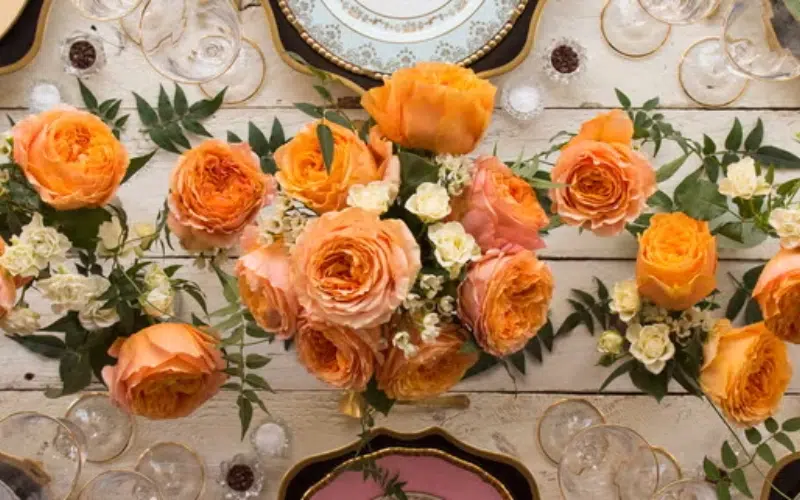
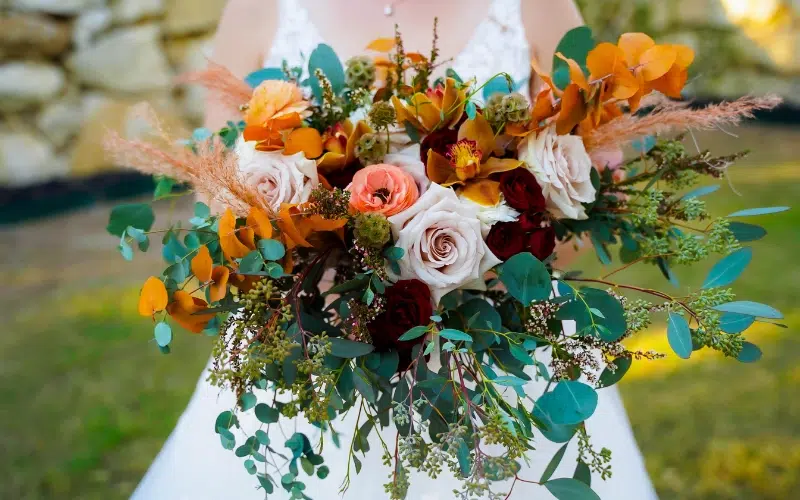
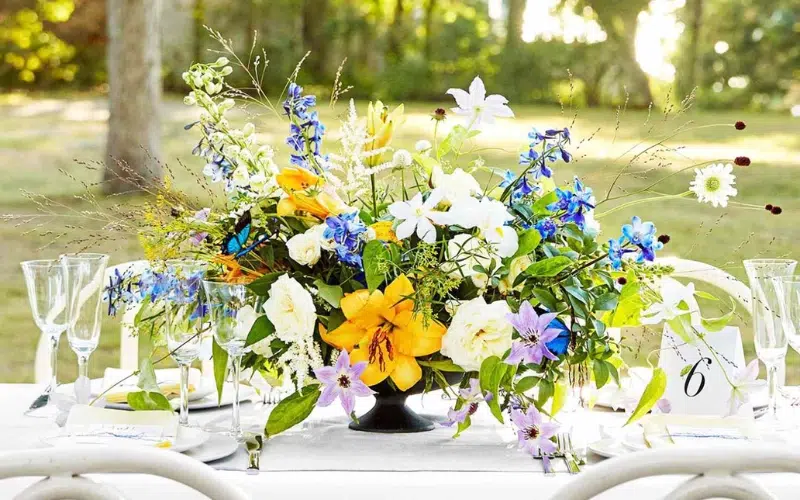
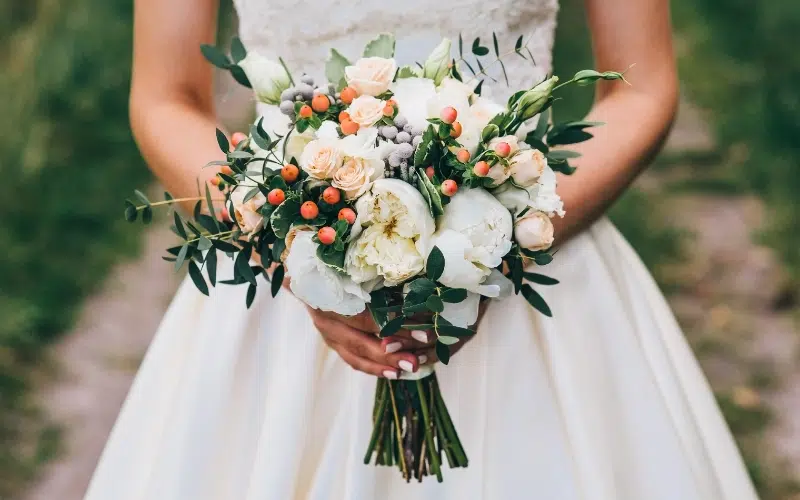
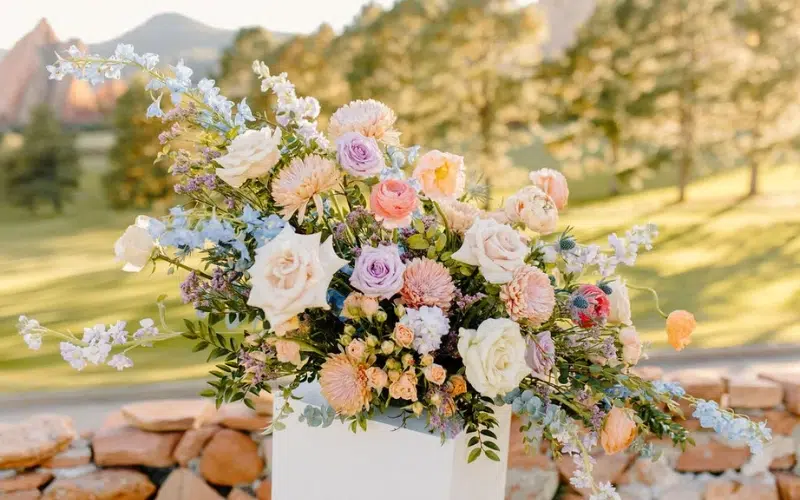
Floral Designers
Good floral design is mostly about placement and restraint rather than volume, and it’s the thing couples get wrong most often when they budget for flowers.
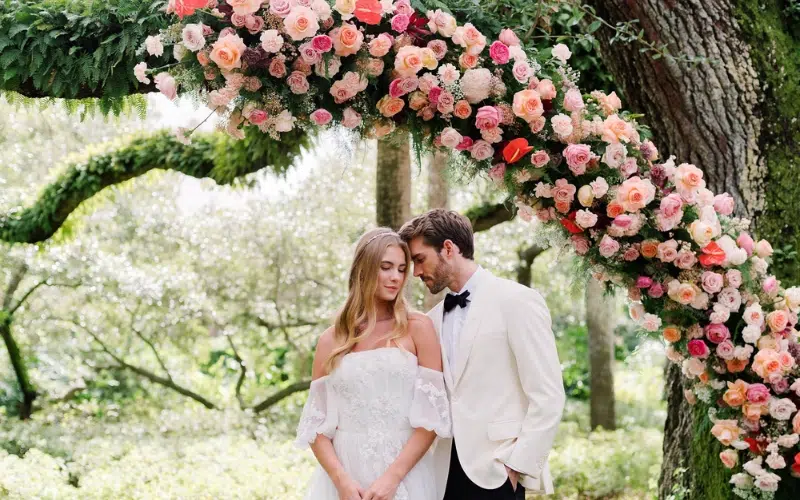
The instinct is to spread the money around: arrangements on every table, a few at the entrance, something at the bar. What works better is putting most of it in two or three places where people actually look. One substantial installation over the dance floor or the top table does more than twenty small vases. A meadow planted along the aisle reads far better than arrangements set at intervals down it.
Repeat colour rather than repeating arrangements. Three or four tones carried from the ceremony through drinks to the tables gives a wedding coherence, and it’s what makes a venue look designed rather than decorated. The flowers themselves can vary considerably as long as the palette holds.
Think about where the eye goes. During the ceremony everyone is looking at one point for twenty minutes, so that’s where the money belongs. At dinner people are looking across the table at each other, which is why low arrangements work and tall ones get moved. And the dance floor is where the photographs happen after dark, so lighting matters more than flowers there.
Most of it can be moved. The ceremony arch becomes the backdrop behind the top table. Aisle arrangements go onto the dinner tables during the drinks reception. A good florist plans that in from the start, and it can cut what you spend on flowers substantially without any visible difference.
And plan around the heat. On this coast in summer, certain blooms won’t last the afternoon. Your florist should be steering you towards varieties that hold rather than the ones in the inspiration photographs, and if they aren’t raising it unprompted, that tells you something.
Floral Styling Ideas
 Romantic garden styling with roses, delicate blooms, and soft trailing greenery
Modern minimalist arrangements using clean lines, negative space, and tonal palettes
Bold colour-pop designs with bright accents and confident statement centrepieces
Textural boho styling with pampas, dried elements, rattan details, and warm neutrals
Mediterranean inspired florals with olive branches, citrus touches, and sunlit colour palettes
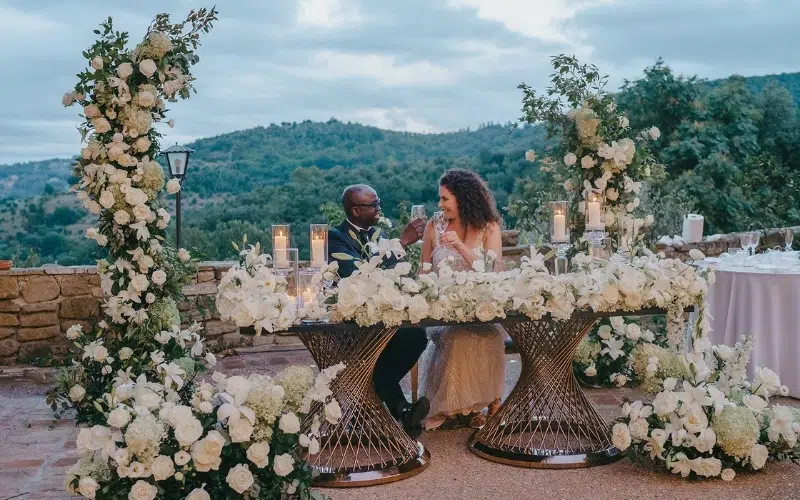
Elegant monochrome looks in all-white, all-green, or deep moody tones for drama
Statement installations such as floral arches, hanging florals, and staircase features
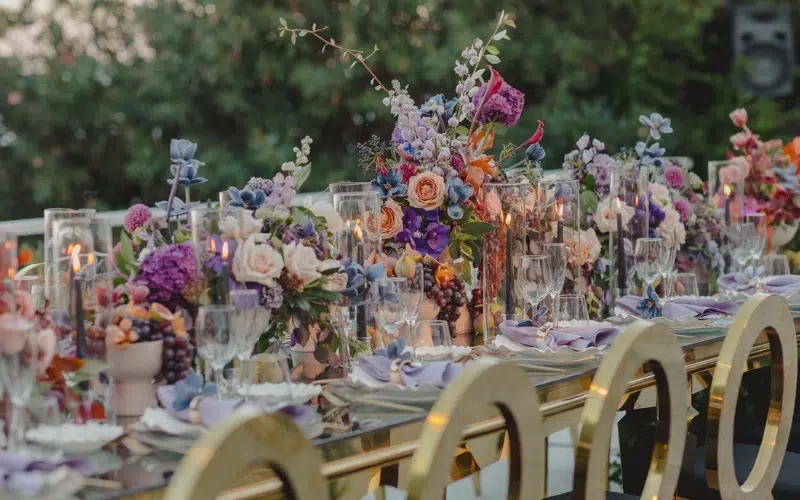
Layered tablescapes combining bud vases, candles, runners, and low centrepieces for depth
The Benefits Of Hiring a Professional Florist
The obvious answer is that they know flowers. The more useful one is that they know what happens to flowers between the shop and eight o’clock in the evening.
Conditioning is most of the job. Stems cut, hydrated and held at the right temperature for a day or two before the wedding. It’s unglamorous and it’s the reason a professional’s bouquet still looks alive at the speeches while a supermarket one has given up by the drinks reception.
Heat is the constraint here. Certain varieties won’t survive a Spanish afternoon in July, and the blooms couples arrive wanting are often the ones that struggle. Hydrangeas wilt fast. Pale roses brown at the edges. A florist who works this coast steers you towards varieties that hold, keeps everything out of direct sun until the last moment, and builds arrangements accordingly.
Scale is the other thing. Arrangements that look generous on a kitchen table disappear in a courtyard with high walls, and centrepieces that photograph well are frequently too tall to see across. Knowing how a design reads in a particular space is experience rather than taste.
And they’ll tell you what to reuse. The ceremony arch behind the top table. Aisle arrangements moved onto the dining tables during drinks. Done properly, that can cut your flower budget substantially with no visible difference, and it’s the first thing a good florist will suggest.
Practically, they handle sourcing, conditioning, transport, installation and collection. That last one matters more than couples expect: someone has to clear the venue at one in the morning, and it shouldn’t be your family.
Wedding Flowers & Styles
Most couples arrive with a Pinterest board and no idea what any of it costs or whether it works in their venue. This is the part where those decisions get made.
Broadly, flowers do three jobs at a wedding. They mark the ceremony, where everyone looks at one point for twenty minutes. They dress the tables, where people spend the longest. And they create the evening atmosphere, where lighting usually matters more than the flowers themselves.
The elements below cover both: the pieces you’ll definitely need, like the bouquet and buttonholes, and the ones worth considering, like arches, hanging installations and aisle meadows. Each has a rough cost and a note on where it works, so you can see what your budget actually buys before you brief anyone.
Two things worth knowing before you read on. Scale reads differently in a Spanish venue than in the photographs you’ve saved, because courtyards and open gardens swallow arrangements that would fill a marquee at home. And almost everything here can be moved from the ceremony to the reception, which is the single easiest way to get more from the same spend.
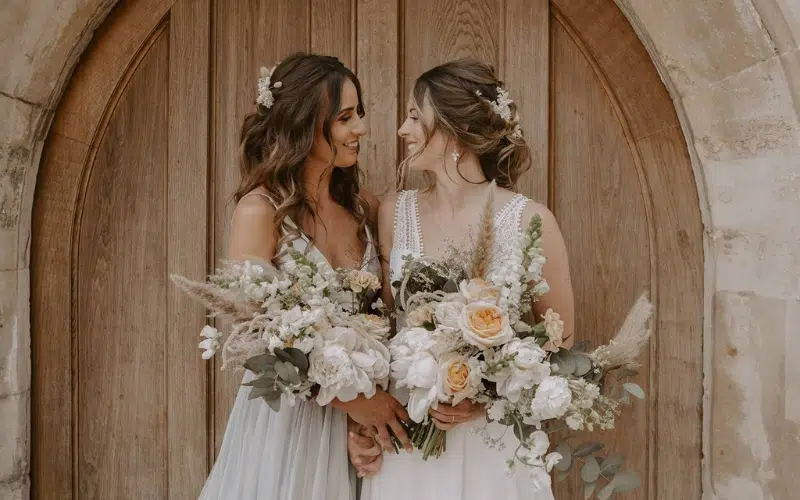
Bridal Bouquets
You’ll carry it for about twenty minutes and it will appear in several hundred photographs, which is worth knowing when you’re deciding what to spend.
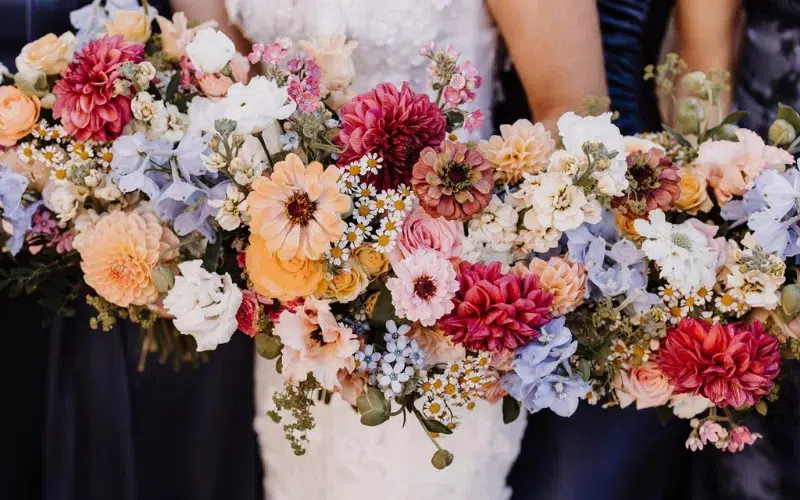
The shapes, briefly. A round bouquet is compact, formal and the safest choice. A hand-tied garden style is looser and more natural, and it suits an outdoor Spanish wedding better than almost anything else. A cascade trails downwards and reads as dramatic and traditional; it also weighs more than couples expect. Sculptural and asymmetrical designs are the current direction, using varied stem lengths and textured foliage rather than density.
Scale matters more than style. A bouquet that looks generous on a table can disappear against a full skirt, and one built for a slim column dress will overwhelm it. Take a photograph of your dress to the consultation, because it’s the single most useful thing you can bring.
On flower choice, the honest position is that peonies are what most couples want and are only available for a short window, roughly April to June, and expensive outside it. Roses, ranunculus and garden roses give a similar feel and are available for longer. Anything imported specially will cost noticeably more, and in Spain that’s a good deal of what’s on offer.
And in the heat, ask your florist what will still look alive at eight in the evening. That question changes the answer more than any conversation about style.
Cost. Expect €120 to €300 for a bridal bouquet in Spain, more for anything cascading or built from out-of-season blooms.
Ceremony Flowers & Aisle Styling
The ceremony is where flowers earn their money, because it’s the one point in the day when everyone is looking at the same spot for twenty minutes. If your budget is tight, this is where to spend it.
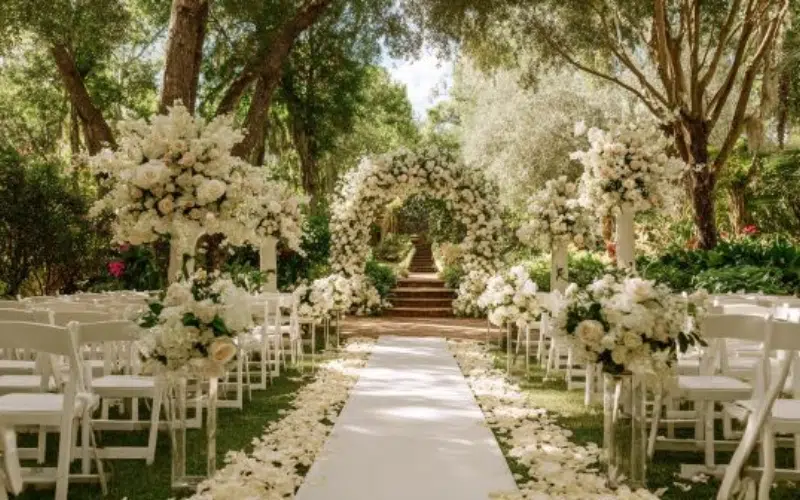
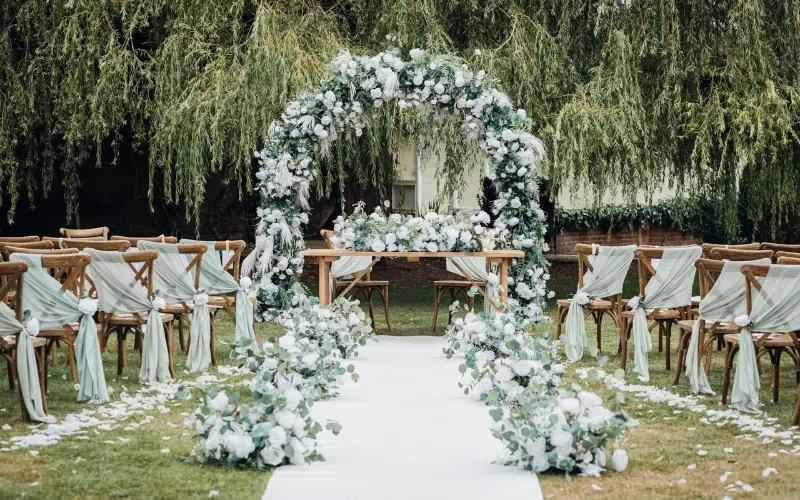
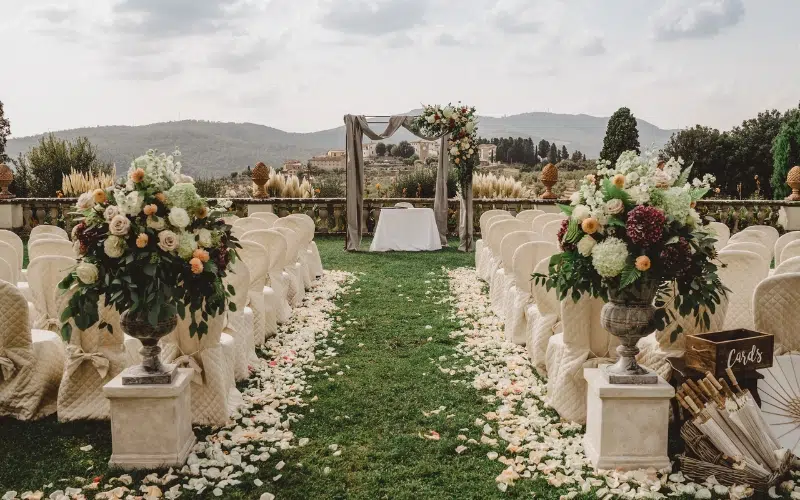
Arches and backdrops are the obvious choice and the most photographed. A full arch runs €800 to €2,500 depending on density; a partial or asymmetric one costs considerably less and often photographs better, because it frames you rather than surrounding you.
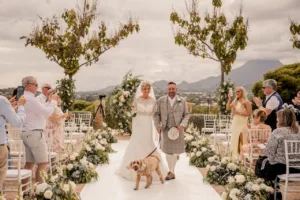
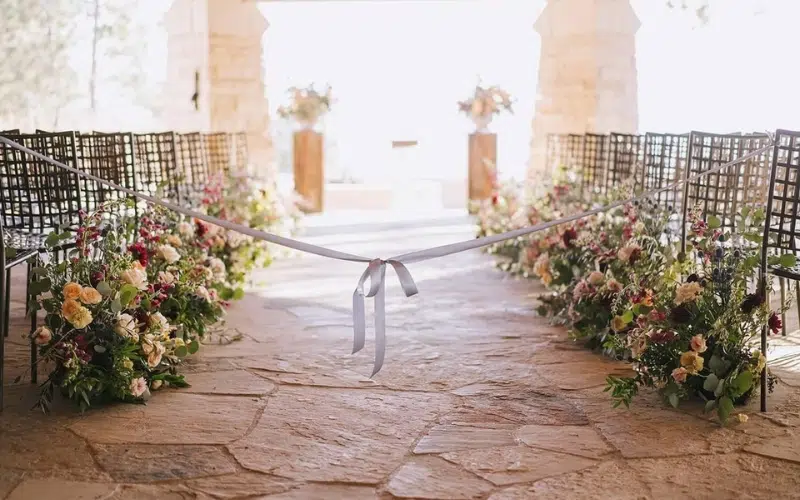
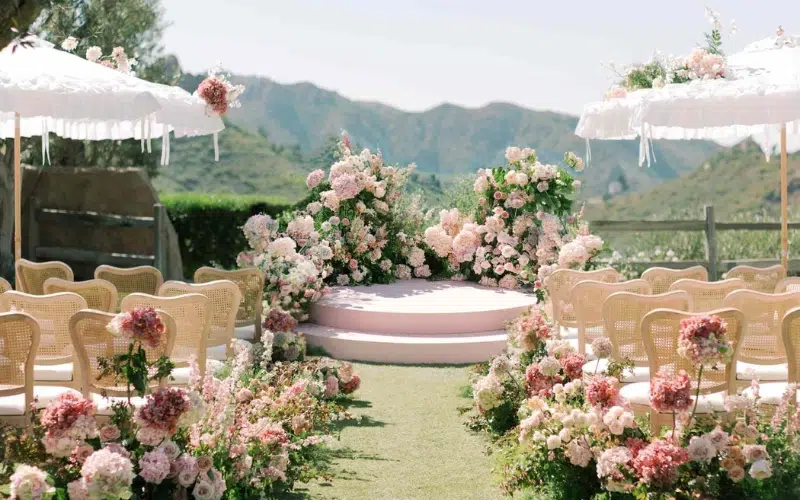
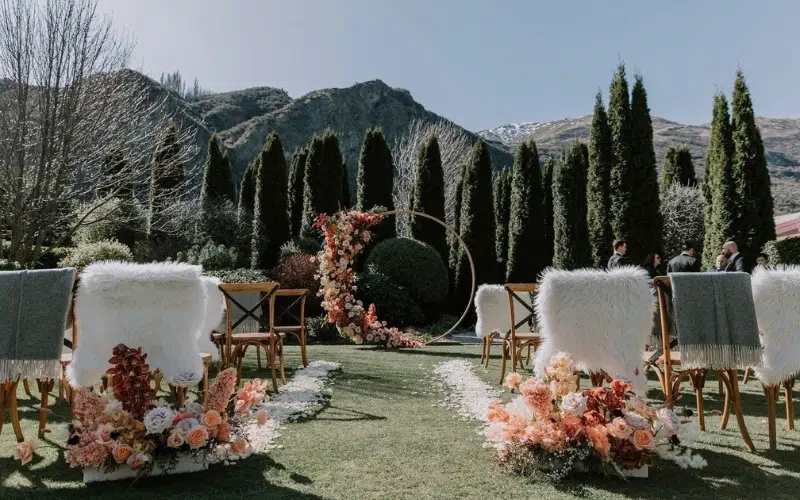
Grounded meadows along the aisle, where flowers appear to be planted rather than arranged, are the current direction and they suit Spanish venues particularly well, since the stone and gravel underfoot gives them something to sit against. Expect €600 to €1,500 depending on length.
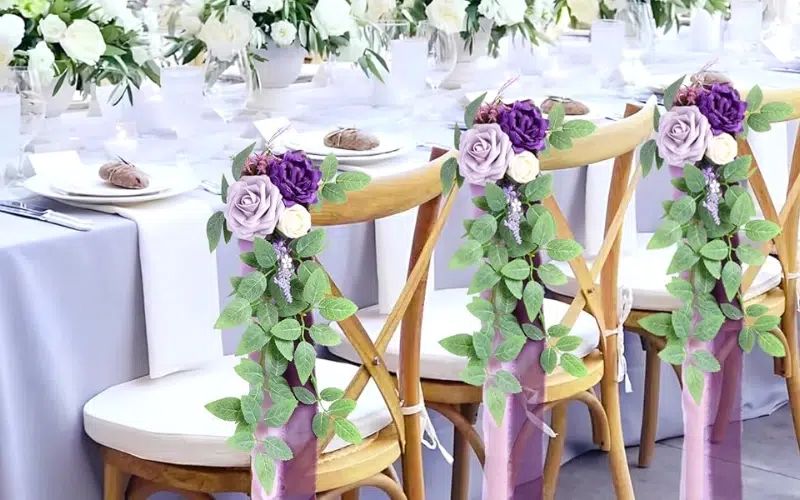
Chair and aisle-end arrangements are the cheapest way to add colour, at €15 to €40 each, though on a wide aisle in an open courtyard they can look sparse. Fewer, larger pieces usually read better than many small ones.
Two practical things. Wind matters more here than couples expect, particularly at coastal and clifftop venues, and anything freestanding needs weighting or securing properly. And sun determines what survives: an arch in full afternoon light at a July wedding needs varieties chosen for it, not for the photograph you saved.
And plan the move. Almost all of this can be repurposed. The arch becomes the backdrop behind the top table, the aisle arrangements go onto the dining tables during the drinks reception. Agree it with your florist at the quote stage, because it needs building into how the pieces are constructed.
Reception Centrepieces & Tablescapes
Dinner is the longest part of the day and the part guests spend closest to the flowers, so the rules are different here from the ceremony.
Keep them low, or keep them clear. The only real mistake at table height is blocking the view across. Anything between roughly 25 and 60cm sits exactly in the sightline, so arrangements should either stay below that or lift well above it on a stand. Getting this wrong is the single most common reason centrepieces end up moved to the floor by the main course.
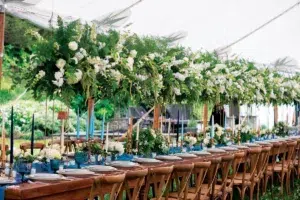
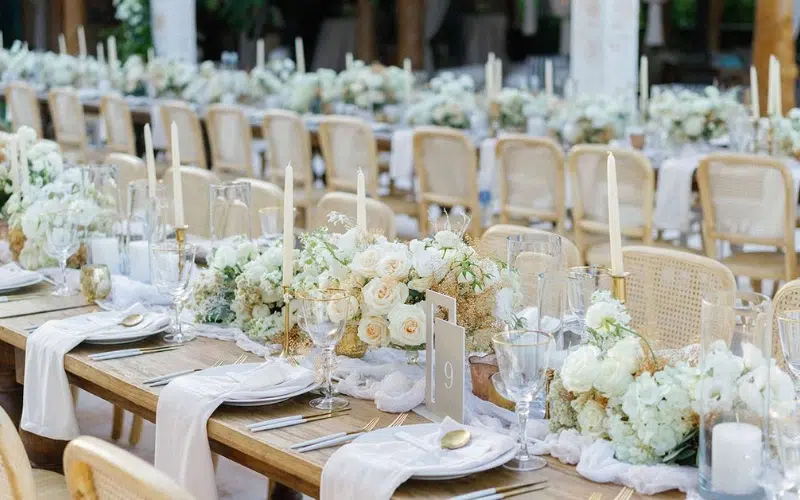
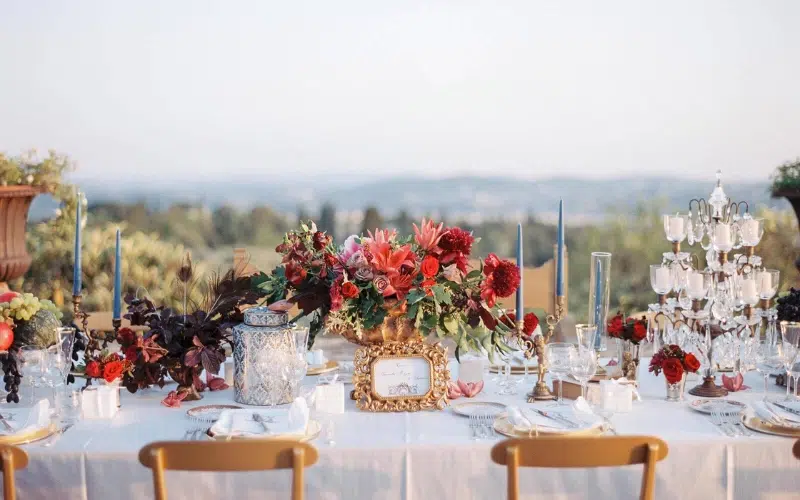
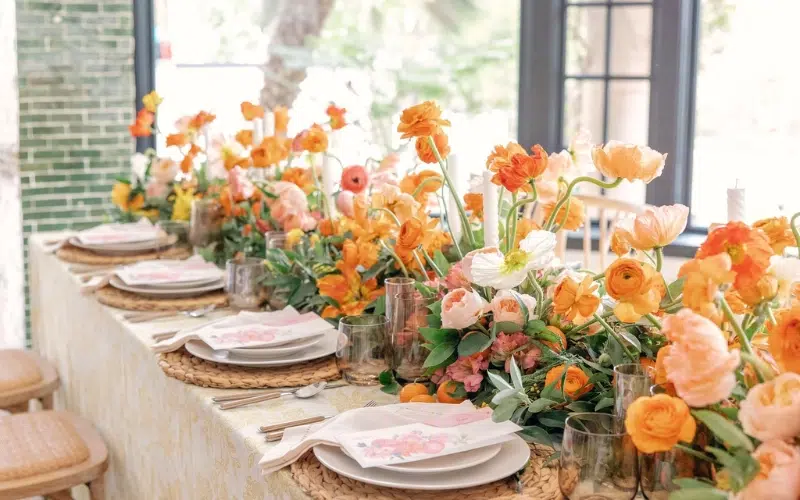
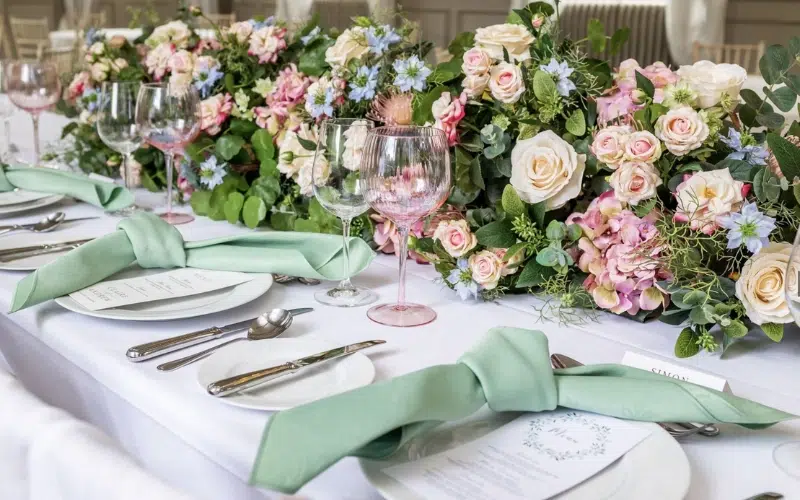
Long tables suit runners. A meadow-style line down the middle, or a series of small arrangements reading as one, works better than isolated pieces and it’s what most Spanish venues are set up for. Expect €40 to €120 per metre depending on density.
Round tables suit a single centrepiece. Low and generous rather than tall and narrow. €50 to €150 per table is a reasonable range.
Bud vases are the value option. Clusters of three or five, mixed heights, using single stems. They look considered, they cost a fraction of a full centrepiece, and they’re easy to fill out with candles.
And candles do more than flowers after dark. In Spain you’ll be eating as the light goes, and by nine the room is lit by whatever’s on the table. Layered candlelight, tapers, votives, a few pillars, changes the atmosphere more than another €500 of flowers would. Worth checking your venue permits naked flame outdoors, since some don’t, and having hurricane glass either way because of the breeze.
And this is where your ceremony flowers should end up. Aisle arrangements moved onto the tables during the drinks reception, the arch behind the top table. Agree it at the quote stage.
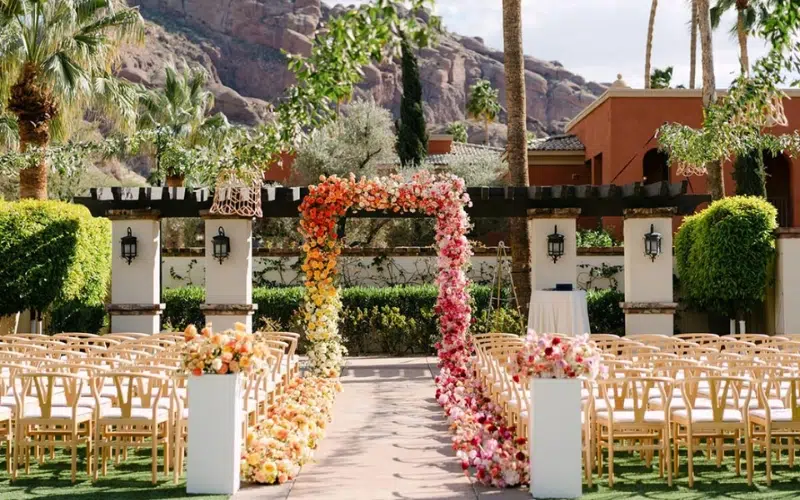
Statement Installations
If you’re going to spend properly on flowers anywhere, this is where it shows.
The principle is simple: one large piece will always beat several small ones. A suspended installation over the dance floor, a garland down a staircase, a full entrance arrangement. Guests notice it, photographers use it, and it defines the look of the day in a way that scattered arrangements never do. Ten tables at €100 each and one installation at €1,000 cost the same and produce completely different results.
Suspended pieces work best over a dance floor or a long table, and they’re the current direction because they add volume without taking up floor space. They need a fixing point, though, which many Spanish venues don’t have, and the rigging is often the larger part of the cost. Ask early, because it can rule a venue out.
Entrance and staircase pieces are the better value option. They’re the first thing guests see, they’re straightforward to install, and they photograph well during arrivals when everyone has a drink and a phone.
Outdoors, wind is the constraint. Anything freestanding or suspended in an open courtyard needs proper weighting and structural fixing rather than optimism. A good florist will build for it. One who hasn’t worked coastal venues may not.
Cost. Suspended installations typically run €1,500 to €5,000 including rigging. Entrance and staircase pieces are usually €400 to €1,500.
And this is the one that can’t be repurposed, which is worth knowing when you’re deciding where the budget goes. An arch moves. A ceiling installation doesn’t.
Flowers That Enhance Your Theme
The mistake couples make is choosing flowers from a Pinterest board and then finding a venue, rather than the other way round. The setting decides more than the theme does.
Whitewashed and rustic venues, the cortijos and fincas, hold colour well because the walls are neutral and the light is hard. Olive branches, eucalyptus, warm terracotta and ochre tones look native here, and dried textures and pampas work better against stone than against anything else.
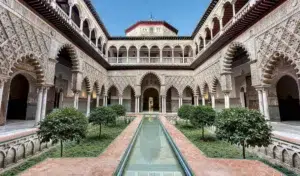
Historic and grand venues, castles, palacios, formal gardens, already have visual weight. They need less rather than more, and structured, restrained arrangements read better than abundance. This is where minimal and sculptural styles earn their place.
Coastal and beach venues wash everything out. Pale flowers disappear against bright sand and hard midday light, and white looks grey in photographs. Stronger colour holds up considerably better, which is the opposite of what most couples expect from a beach wedding.
City and modern venues suit clean lines: orchids, anthuriums, single-variety arrangements and structured foliage rather than garden looseness.
On seasonality, be aware that most wedding flowers in Spain are imported, so what’s “in season” locally often isn’t what determines availability or price. Peonies are the exception worth planning around, since they’re roughly April to June and expensive outside it. Olive, eucalyptus and Mediterranean foliage genuinely are local, cheap and available year-round, which is part of why they appear on every Spanish wedding.
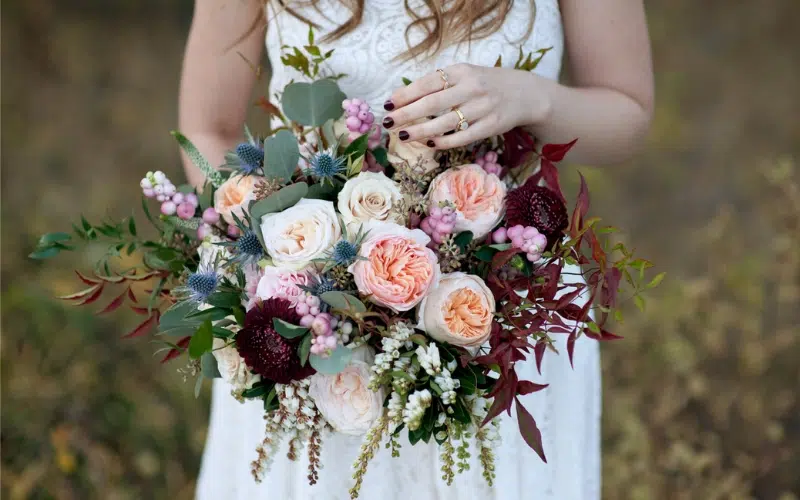
Roses and peonies for romantic themes
The most requested look and the most familiar: roses, peonies, ranunculus and soft greenery in ivory, blush and dusty pink.
On peonies, be realistic. They’re what most couples picture and they’re available roughly April to June, expensive outside it and sometimes not available at all. If your date falls outside that window, garden roses and ranunculus give a very similar feel for considerably less, and your photographs won’t tell the difference.
On pale palettes in Spain, one caution. Ivory and blush wash out under hard midday light and against pale stone, which describes most Andalusian venues. Adding depth, dusty rose, terracotta, a darker foliage, keeps a romantic palette from disappearing in the photographs without making it any less soft.
Foliage does the work. Eucalyptus is the default here and it’s cheap, local and reliable. Olive is the same and looks more native to a Spanish setting. Both bulk out arrangements at a fraction of what more flowers would cost.
Where it suits best: whitewashed cortijos, garden venues and historic estates, where the architecture is already soft. It works less well at sleek modern venues, where the contrast tends to read as mismatched rather than deliberate.
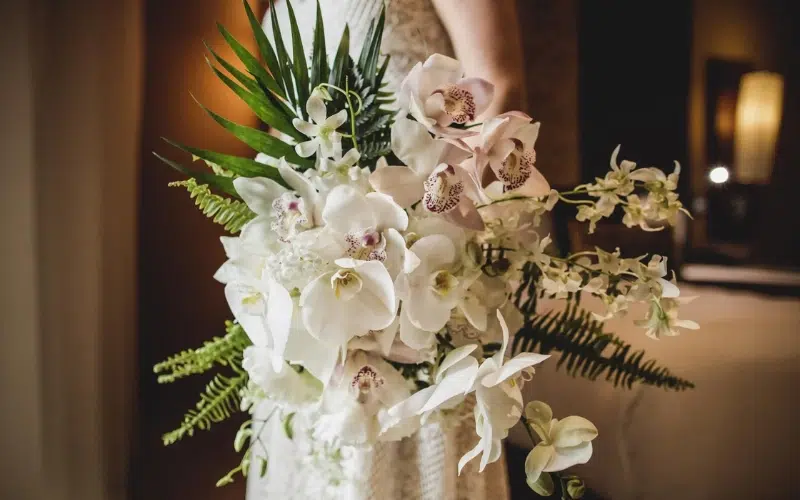
Orchids and structured blooms for modern styling
Orchids, anthuriums, calla lilies and single-variety arrangements, with clean foliage lines and structured vessels rather than loose garden shapes.
The reason it works here is that Spanish light is hard and Spanish architecture is often stark. Whitewashed walls, stone, strong shadows. Structured flowers hold their shape against that, where soft romantic arrangements can look washed out in the middle of the day.
It’s also the most heat-resistant style available. Orchids and anthuriums are waxy and hold for hours in conditions that flatten a hydrangea by four o’clock. If you’re marrying in July or August, this is the palette that survives the afternoon.
Less is genuinely more, and it’s cheaper. A single stem in a good vessel, repeated down a table, costs a fraction of a full centrepiece and looks deliberate rather than sparse. The money goes into the vessels and the repetition instead of the volume, which is where minimal styling tends to be misunderstood.
Where it suits best: modern villas, city venues, rooftop terraces and anywhere with clean lines. It works less well at rustic fincas, where it can read as underdressed against stone and beams.
Worth knowing: orchids are almost entirely imported and priced accordingly, so minimal doesn’t automatically mean cheap. The saving comes from using fewer of them, not from them being inexpensive.
Olive branches for Mediterranean settings
Olive branches, eucalyptus, wild grasses and citrus, in sun-bleached tones: sage, cream, terracotta, ochre.
This is the one that actually belongs here, and it’s the best value on the page. Olive and eucalyptus are grown locally rather than flown in, which makes them a fraction of the cost of imported blooms, and they hold up in heat when almost nothing else does. A florist can build most of an arrangement from foliage and use flowers as accents, which is why Mediterranean styling routinely comes in below a romantic palette for the same visual weight.
It also suits the venues. Whitewashed cortijos, stone courtyards, olive groves. The foliage matches what’s growing outside, so nothing looks imported into the setting, which is more than can be said for a hydrangea arch in Andalucía.
Citrus is worth considering and couples rarely think of it. Lemons and oranges in arrangements or along a table look unmistakably Spanish, cost very little, and photograph well against neutral linen.
One caution. Done carelessly it tips into looking like a restaurant table dressing rather than a wedding. The difference is scale and repetition: substantial pieces used consistently, rather than a few sprigs of olive scattered about. If the budget is genuinely tight, this style rewards concentrating it in two or three places more than any other.
Where it suits best: fincas, cortijos, rural estates and anywhere outdoors. It’s the natural fit for inland Andalucía, Mallorca and the Costa del Sol.
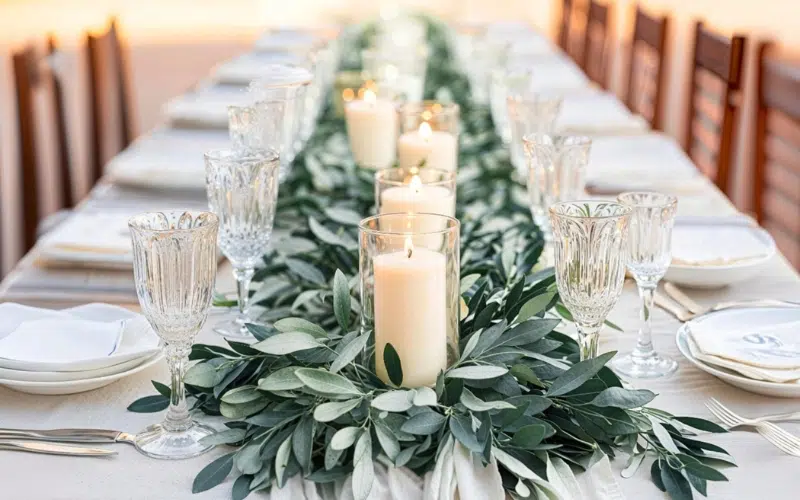
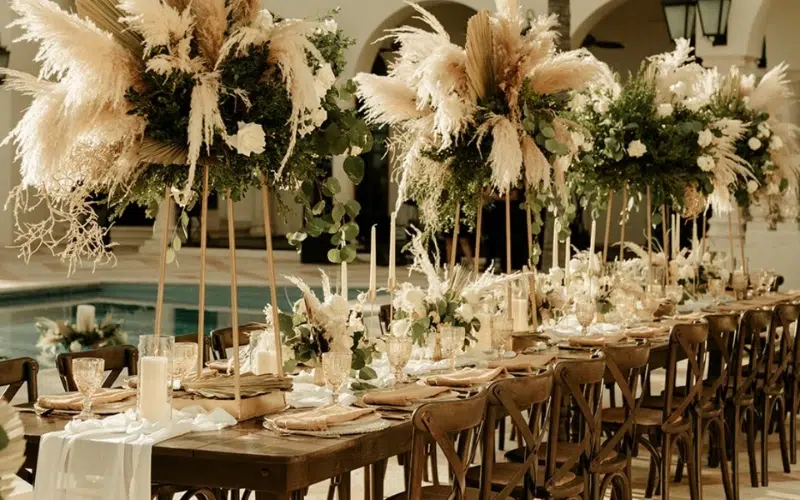
Dried elements for boho designs
Pampas grass, dried palm, bleached foliage and preserved textures in warm neutrals: sand, rust, bone, soft caramel.
The practical advantage is that dried flowers don’t wilt. Nothing else on this page can be installed the day before and look identical at midnight in August. For an outdoor summer wedding in Spain, that’s a genuine advantage rather than a stylistic preference.
They’re also reusable and transportable, so a dried arch genuinely can move to the reception without anyone worrying about water sources or heat, and pieces can be made well in advance rather than the morning of.
On cost, dried is often assumed to be the cheap option and frequently isn’t. Good pampas and preserved foliage cost more per stem than you’d expect, and the volume needed for a full installation adds up. Where it saves is in labour and logistics rather than materials.
Two things to check. Some venues won’t allow pampas indoors, since it sheds and is a fire risk near candles, which matters when your evening styling is built around candlelight. And it has dated faster than any other wedding trend of the last decade, so if you’re marrying in two years, think about whether you’ll still want it.
Where it suits best: beach and coastal venues, rustic fincas, and anywhere with a relaxed, barefoot feel. It looks out of place at formal or historic venues, where the contrast reads as underdressed rather than deliberate.
Seasonal flowers for cohesion and sustainability
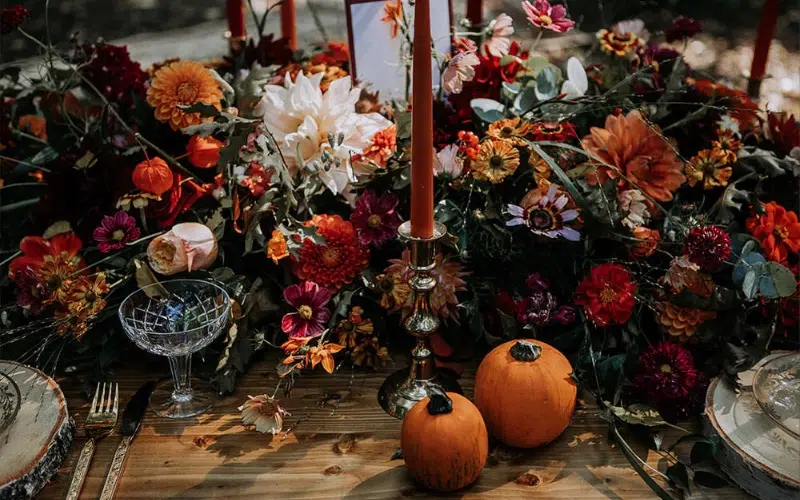
Flowers outside their season cost substantially more. That’s the single most useful thing to understand before you brief a florist, and it’s where most flower budgets quietly overrun.
How much more. Out-of-season stems typically run two to three times the in-season price, and sometimes considerably above that. Peonies are the clearest example: roughly €4 to €6 a stem in May, and €15 or more in September if they can be sourced at all. On a bouquet, that’s the difference between €150 and €400. Across a full wedding, it’s thousands.
The seasons that matter:
| Flower | In season | Out of season |
|---|---|---|
| Peonies | April to June | Very expensive, often unavailable |
| Ranunculus and anemones | Winter to spring | Limited and costly |
| Dahlias | Late summer to autumn | Not available |
| Garden roses | Late spring to autumn | Priced up sharply |
| Standard roses, orchids, lisianthus | All year | Stable pricing |
And be aware that “seasonal” in Spain often means the Dutch auction calendar rather than what’s growing locally. Most wedding flowers here are imported, so the season that affects your price is the growing season wherever they’re actually from.
What genuinely is local and available all year is the foliage: olive, eucalyptus, rosemary, wild grasses and citrus. It costs a fraction of imported stems, holds up in heat, and building your arrangements around foliage with flowers as accents is the most effective way to cut a flower budget without it showing.
The practical advice. Give your florist your palette, your date and your budget, and let them choose the varieties. Couples who specify exact flowers regularly pay two or three times what those who specify colours and textures do, and in photographs the difference is invisible.
Top 10 Tips To Find The Perfect Floral Designer
Flowers are usually the third or fourth largest line in a wedding budget and the one couples know least about when they start briefing.
That’s a difficult position to negotiate from. You’re being quoted for something you can’t easily price-check, by someone whose portfolio looks like everyone else’s, for a product that doesn’t exist until the morning of your wedding.
The ten below are the things worth establishing before you commit, and most of them have nothing to do with taste. Whether they’ve worked your venue. What survives the heat in your month. Whether the quote includes installation and collection. What’s actually achievable at your budget rather than what’s on your mood board.
Get those settled and the creative conversation becomes much easier, because you’ll both be working from the same reality.
1. Review Their Portfolio Carefully
Every florist shows you their twenty best frames from a hundred weddings, and every portfolio looks excellent. Ask for one complete wedding instead: ceremony, tables, evening, all of it.
That tells you what a portfolio can’t. Whether the styling held together across the day or peaked at the arch. Whether the table arrangements were as considered as the installation. And crucially, what everything looked like at eight in the evening rather than at four when the photographer was shooting details.
2. Ask About Seasonal Knowledge
Seasonality here is less about what’s growing locally and more about what holds up in the heat. Most Spanish wedding flowers are imported anyway, so the useful question isn’t “what’s in season” but “what will still look alive at eight in the evening in July?”
A florist who works this coast answers immediately, and will steer you away from hydrangeas in August without being asked. One who doesn’t raise it unprompted hasn’t done many summer weddings here.
Out-of-season stems also cost two to three times the in-season price, so ask what your palette costs in your month specifically.
Tip: Give them your colours and your date, not a list of flowers. You’ll pay considerably less for the same result.
3. Discuss Budget Openly
Not a range, not “flexible”, an actual figure. Florists can design to almost any budget, but only if they know what it is, and the alternative is a proposal you can’t afford followed by an awkward conversation about cutting it back.
A good designer will tell you honestly what your number buys. If the arch you’ve saved costs €2,500 and you have €1,800 for the whole wedding, better to hear that in the first meeting than the third.
And ask what they’d do with your budget. The answer separates the good ones. Most will say concentrate it: one substantial piece rather than spreading it thin, and repurpose the ceremony flowers at the reception. That advice alone is worth having.
Tip: Ask what your budget realistically covers before you show them your inspiration board.
4. Check Full Service Offerings
Delivery, setup and styling are usually in the quote. Collection often isn’t, and that’s the one that catches people out, because someone has to clear vases, stands and structures from the venue, frequently the following morning, and most venues charge if it isn’t done.
Ask specifically: does the quote cover setup, does it cover collection, and if there’s a hire element on vessels or structures, when do they need returning and who does it.
Also ask whether they’ll be on site during the day. Moving ceremony flowers to the reception, topping up water in the heat, and fixing whatever the wind has done all need someone present. Some florists deliver and leave.
Tip: Get setup and collection confirmed in writing. It’s the most common gap between a quote and a final invoice.
5. Ask About Large Installations
5. Ask what your venue actually allows
Large installations are as much a structural problem as a design one, and the constraint is usually the venue rather than the florist.
Suspended pieces need a fixing point, and plenty of Spanish venues don’t have one. Historic properties often restrict what can be attached to walls or beams. Some won’t permit naked flame outdoors, which matters if your styling involves candles. And anything freestanding outdoors needs proper weighting, because wind at a coastal or clifftop venue is a genuine problem rather than a footnote.
A florist who’s worked your venue knows all of this already. One who hasn’t should be asking to visit before quoting.
Tip: Ask whether they’ve worked your venue before. If not, ask whether they’ll do a site visit and whether it’s chargeable.
6. Understand Their Planning Process
Most florists work from a mood board to a proposal, then refine it. The useful questions are about what happens after that.
How many revisions are included before it starts costing? When are final numbers due, and what happens if your guest count changes at six weeks? Is the quote fixed, or subject to market pricing on the day, which is more common than couples expect given flowers are bought at auction?
And what’s the deposit, when is the balance due, and what happens if you cancel or move the date.
Tip: Ask whether the quoted price is fixed or indicative. With imported flowers it’s often the latter, and it’s better to know now.
7. Look for Venue Experience
A florist who’s worked somewhere will have an opinion about it, and the opinion is more useful than the reassurance.
Ask what they’d do differently at your venue, or what most couples get wrong there. A good answer sounds like: the ceremony spot gets full sun until seven so anything pale will suffer, or the courtyard swallows arrangements so you need fewer and larger, or there’s nowhere to fix a hanging installation so don’t plan one.
If they’ve never worked it, that’s not disqualifying. Ask whether they’ll visit before quoting, and whether that’s chargeable.
Tip: A florist who can tell you the venue’s limitations already knows it. One who says it’ll be beautiful anywhere hasn’t been.
8. Read Genuine Client Reviews
Everyone has five-star reviews for the flowers. What’s worth reading is how they handled the day something went wrong.
Look for mentions of weather, late changes, a supplier failing, a guest count moving at the last minute. A review saying “it poured and they rebuilt the ceremony indoors in forty minutes” tells you considerably more than twenty saying the bouquet was beautiful.
Google, Trustpilot and Facebook are worth more than testimonials on a florist’s own site, and photographs from real couples are worth more than either.
Tip: Ask the florist directly what’s gone wrong at a wedding and how they dealt with it. Everyone has a story. The ones who won’t tell you are the concern.
9. Clarify Timelines and Lead Times
Good florists in Spain are booked twelve to eighteen months ahead for peak Saturdays between May and September. Outside that, and midweek, availability opens up considerably.
The deadlines that matter after booking:
Final guest numbers, usually four to six weeks out, since it determines table quantities.
Final design sign-off, typically the same point, after which changes cost money.
Balance payment, often two to four weeks before, and sometimes earlier than you’d expect because they’re buying stock.
Ask what happens if your numbers move after the deadline, because they usually do.
Tip: Book the florist after the venue and the photographer, not before. Your venue determines half the design decisions.
10. Choose Someone You Trust
The nine points above are all things you can check. This one you have to judge, and the signal is simpler than it sounds.
The florist worth booking is the one who tells you something you didn’t want to hear. That your budget won’t cover the arch you’ve saved. That hydrangeas won’t survive your August afternoon. That the courtyard needs fewer, larger pieces than you’ve planned. That the palette you’ve chosen will disappear against pale stone in midday light.
Anyone who agrees with everything is either not paying attention or intends to have that conversation later, when you’ve paid a deposit.
Nine months out, that matters more than taste. You’re buying judgement as much as flowers, and the person you want is the one who’ll tell you the truth in April rather than manage your expectations in September.
Tip: If a florist agrees with every idea you have, that’s not a good sign.
Contact Us
Make Your Day Special with Us
Start Your Wedding Journey and discover our exceptional services, designed to make your day extraordinary and unforgettable. We look forward to creating wonderful memories with you.
Luxury Weddings in Spain...
Discover your perfect wedding venues in Spain
Start Collecting Floral Designs & Ideas
Where can I get ideas for my wedding flowers?
Most couples arrive at their first florist meeting with forty saved images and no idea what connects them. That’s fine, and it’s how the process should start. What’s less useful is arriving with one image and asking to have it recreated.
The problem with copying a single photograph is that you’re copying a specific venue, in specific light, in a specific month, at a budget you can’t see. The arch you’ve saved may have cost €3,000, been shot in Tuscany in June, and used peonies that aren’t available on your date. Your florist can produce something you’ll love, but it won’t be that.
What works better is looking for the pattern. Go through your saved images and ask what they have in common. Usually it’s a palette rather than a flower, or a density, or a shape. Once you can say “I keep saving loose, low arrangements in warm neutrals” you’ve given your florist something they can work with, and the result will suit your venue rather than someone else’s.
Where to look. Pinterest for range, Instagram for real weddings rather than styled shoots, and florists’ own galleries for full weddings rather than single frames. Our own wedding flower ideas guide covers what works in Spanish venues specifically, which narrows things considerably compared with browsing globally.
One thing to be aware of. A great deal of wedding inspiration online comes from styled shoots rather than actual weddings. Those are built for photography, often with unlimited flowers, no guests and no wind, and shot in an hour. Real weddings look different, and it’s worth asking a florist which of their images are which.
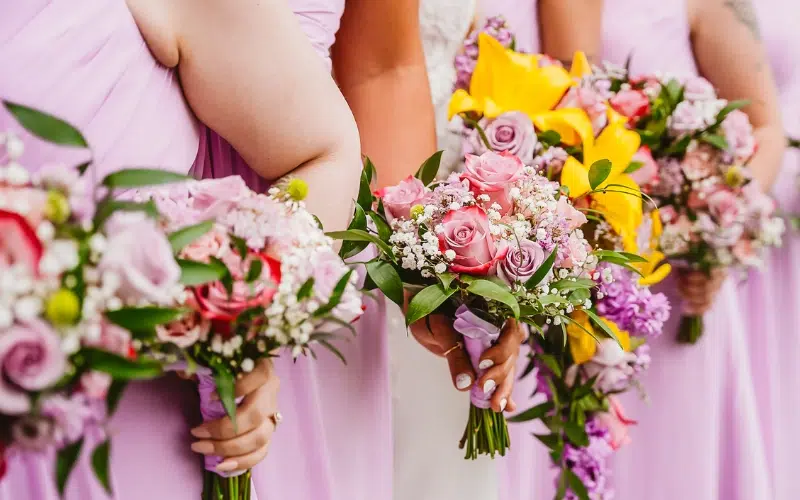
Pinterest boards filtered by colour, season, and venue style: Pinterest is one of the most powerful tools for visual wedding planning because it allows you to search by very specific details such as “summer garden wedding flowers”, “modern white tablescape”, or “rustic barn floral arch”. You can create private boards and organise ideas by ceremony, reception, bouquet, or colour palette. Over time, ideas naturally appear in what you save.
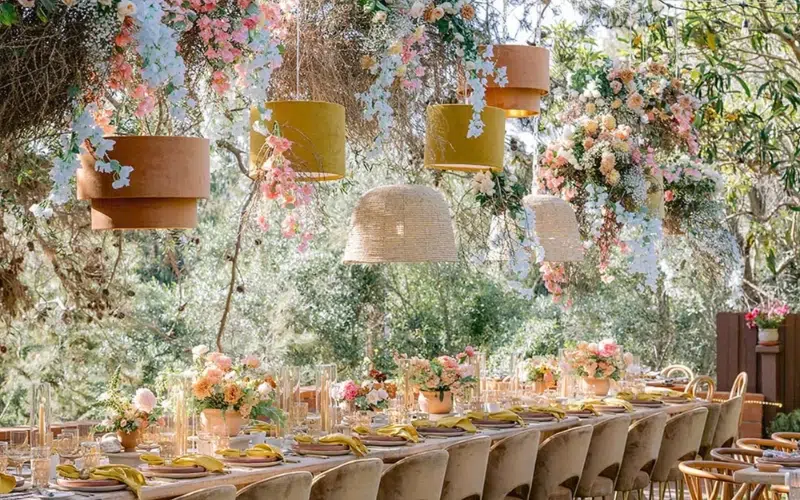
Instagram accounts of florists, planners, and photographers:Instagram offers real time inspiration from professionals actively working in the industry. Florists often share close up details of bouquets and installations, while planners and photographers showcase how florals look within the full wedding setting. Exploring tagged venues and scrolling through recent weddings gives you a realistic sense of scale, and design.
Vendors Websites
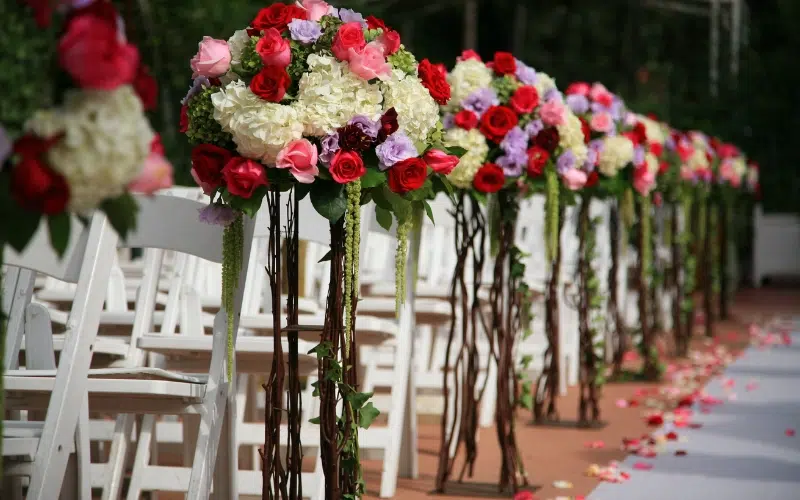
Vendor websites showing complete wedding galleries:Vendor websites provide a more curated and comprehensive look at their work. Unlike social media highlights, websites often feature full wedding galleries that show how florals transition from ceremony to reception. This helps you understand cohesion, styling consistency, and whether a designer can deliver a complete visual story rather than one standout image.
Wedding Blogs
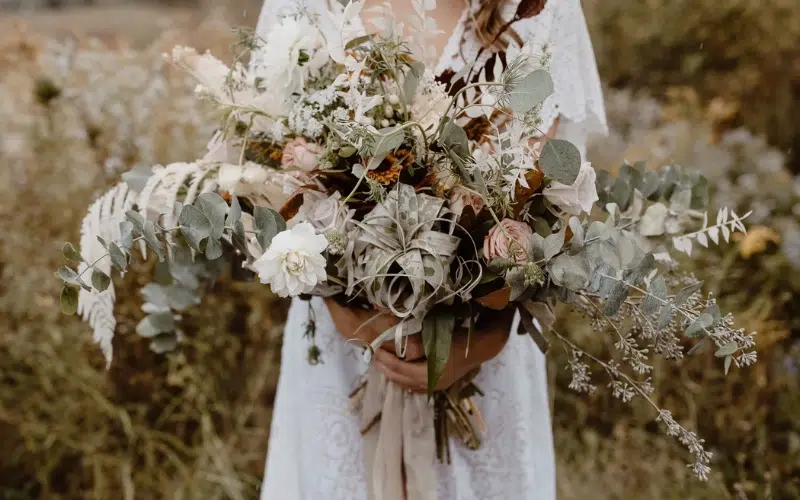
Wedding blogs featuring real wedding editorials: Wedding blogs are excellent for discovering trends, seasonal flower combinations, and professionally styled shoots. Many blogs feature real weddings with detailed supplier credits, allowing you to see how different elements come together. They also offer practical insights into budgets, timelines, and floral choices, helping you turn inspiration into informed decisions.
Popular Floral Wedding Loations
Malaga
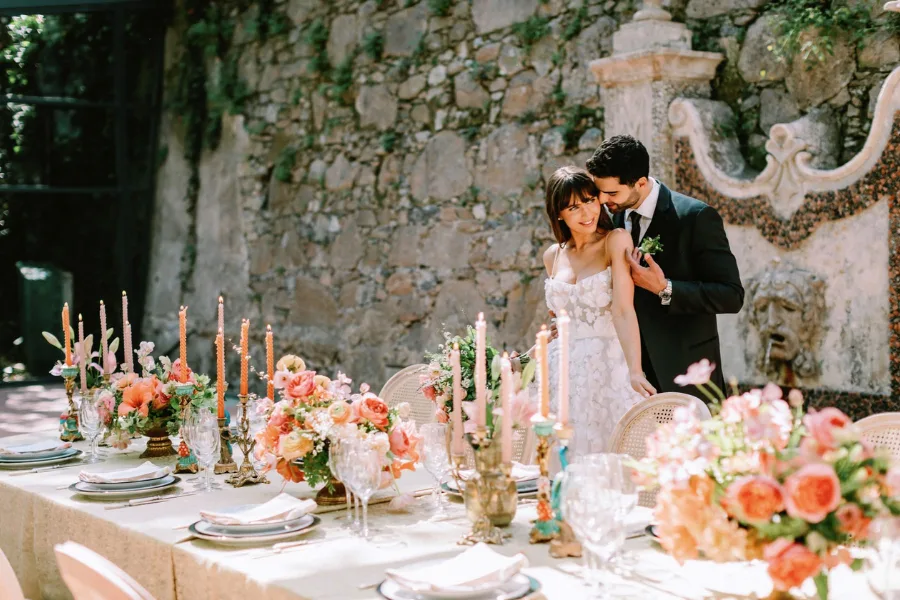
Floral Wedding Designers Malaga
Málaga province asks three different things of a florist, and the difference matters when you’re briefing one.
City venues in the old town and on the rooftops sit against warm stone and hard shadows. Colour holds up here; pale palettes tend to disappear. Structured arrangements read better than loose garden shapes against that architecture.
Coastal venues are the trickiest. Bright sand and reflected light wash out pale flowers entirely, so white looks grey in photographs and blush reads as nothing at all. Stronger tones work considerably better, which is the opposite of what most couples expect from a beach wedding. Wind is a factor too, so anything freestanding needs weighting.
Country estates and fincas inland, towards Coín and Álora, are where Mediterranean styling belongs. Olive, eucalyptus and citrus look native rather than imported, and they’re locally grown, so they cost a fraction of imported stems and hold up in heat when almost nothing else does.
The constraint across all three is temperature. July and August afternoons will flatten hydrangeas and brown pale roses within hours. A florist working here plans around it: varieties chosen for endurance, arrangements kept out of direct sun until the last moment, and everything properly conditioned beforehand.
See our: Wedding venues in Málaga and Wedding venues on the Costa del Sol
Floral Wedding Designers Barcelona
Barcelona has the most adventurous floral scene in Spain, and the highest standard. The city’s design culture shows in the work, and sculptural, colour-led arrangements that would look out of place in Andalucía sit naturally here.
But your venue may have already chosen your florist. Most Barcelona weddings happen at masies, the Catalan farmhouses in El Vallès and the Penedès, and a good number of those work with an exclusive supplier or a short approved list covering styling as well as catering. That’s worth establishing before you fall for a venue, because you may have less say than you expect.
Where you do have a free hand, usually at city venues and some Penedès estates, you have the best supplier market in the country.
City venues need restraint. Gothic Quarter courtyards, modernist buildings and rooftop terraces already have visual weight, and abundant garden styling competes rather than complements. Structured, single-variety arrangements read far better against strong architecture.
Coastal and Costa Brava venues behave differently again: pine, rock and hard light, where stronger colour holds and pale palettes wash out.
On climate, Catalonia is greener and slightly cooler than the south, which widens what’s possible. Flowers that struggle in an Andalusian August will hold here, though September brings Catalonia’s heaviest rain, so an outdoor installation needs a wet-weather plan rather than optimism.
See our: Wedding venues in Barcelona
Barcelona
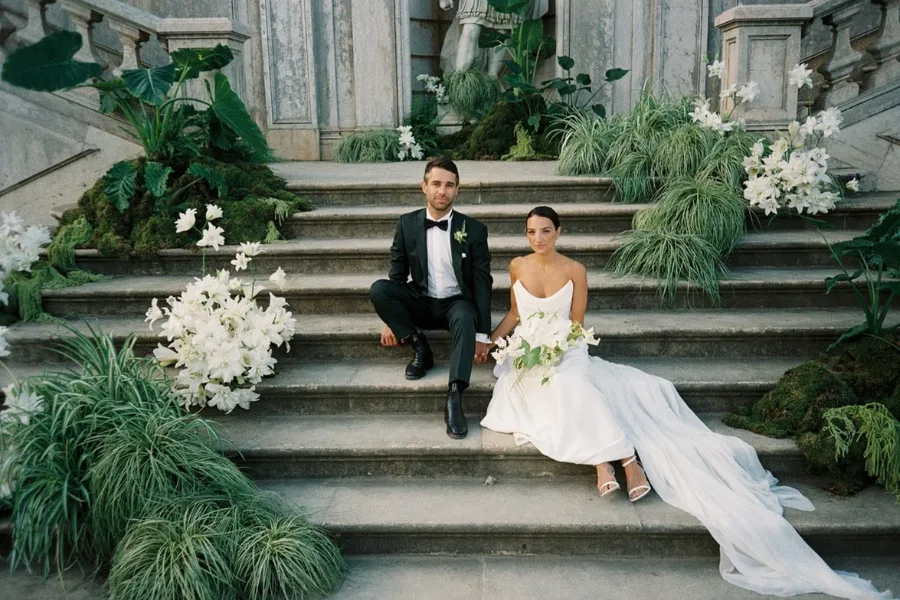
Marbella
Floral Wedding Designers Marbella
We’re based in Marbella, so this is home ground, and we know both the venues and the florists who work them well.
The light is the first thing to plan around. Marbella light is bright and hard, particularly between June and September, and it flattens pale palettes. White reads as grey in photographs, blush disappears entirely against sand and pale stone, and the ivory arch that looked ethereal on Pinterest looks washed out at two in the afternoon. Stronger tones hold up considerably better, which surprises most couples.
Then the heat. Hydrangeas will wilt within hours on a July afternoon and pale roses brown at the edges by the speeches. A florist working this coast steers you towards varieties that endure, keeps everything out of direct sun until the last moment, and conditions properly beforehand. If they aren’t raising it before you do, they haven’t done many summer weddings here.
The venue types split three ways. Beach clubs and coastal properties, where wind matters as much as heat and anything freestanding needs weighting. Private villas in Nueva Andalucía and the Golden Mile, where you have a free hand and installations can be built properly. And the Old Town and inland estates, where stone and shade make the conditions considerably kinder.
And Marbella has the deepest florist market on the coast, which means genuine choice at every price point rather than a shortlist of three. It also means the good ones are booked eighteen months out for peak Saturdays.
See our: Wedding venues in Marbella
Floral Wedding Designers Mallorca
Mallorca is the island where we’d most encourage couples to let the setting lead, because the landscape does most of the work already.
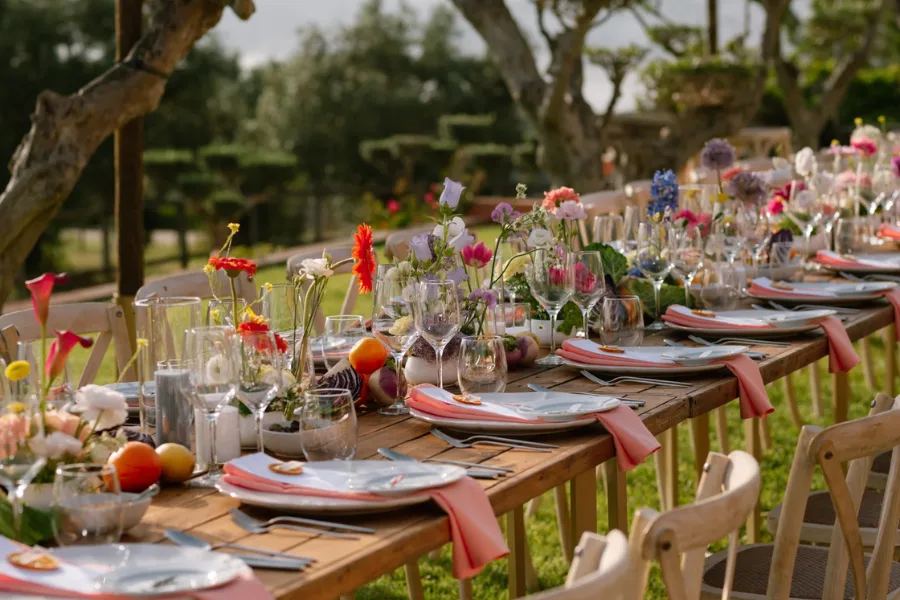
The finca wedding is what the island does, and the styling should follow: long tables under olive trees, loose arrangements, and a palette taken from what’s growing outside rather than from a Pinterest board. Olive, almond, wild fennel and citrus are everywhere here, they’re local rather than imported, and they cost a fraction of what flown-in blooms do while holding up far better in the heat.
The Tramuntana changes the conditions. Venues up in the mountains sit several degrees cooler than the coast and get afternoon shade from the terraces and stone, which widens what survives considerably. Down at sea level around Palma and the south, it’s hotter and brighter, and the usual rules apply: pale palettes wash out, stronger tones hold.
Wind is worth planning for on the north and east coasts, where the tramuntana wind gives the mountains their name and can run for days. Anything freestanding or suspended needs proper structural fixing rather than optimism.
On supply, Mallorca is an island, so imported stems arrive by boat or plane and cost more than they would on the mainland. That’s the practical argument for building around local foliage: it isn’t just that it looks more native, it’s that it’s meaningfully cheaper here than anywhere else in Spain.
And book early. The island’s florist market is smaller than the Costa del Sol’s, the season runs May to early October, and the good ones fill their Saturdays a long way out.
See our: Wedding venues in Mallorca
Mallorca
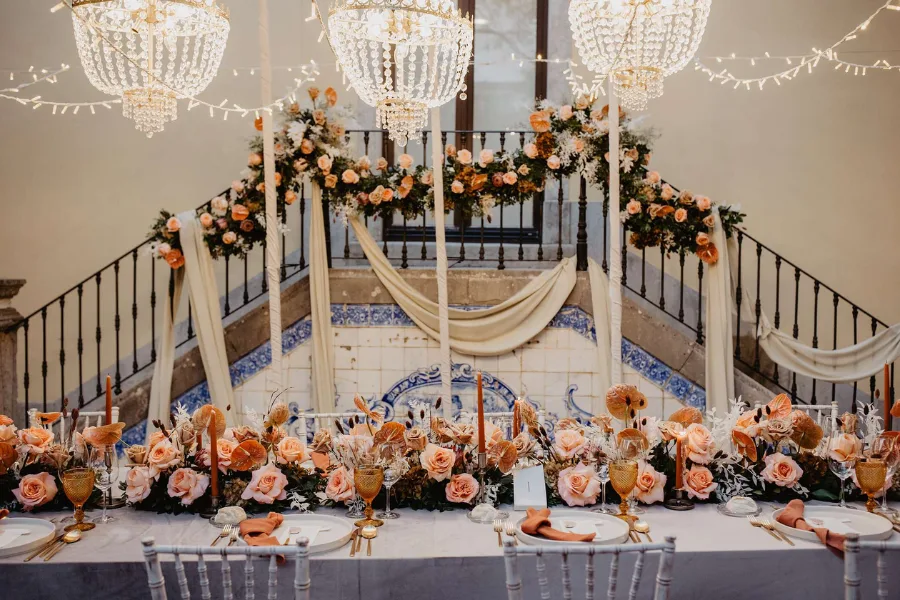
Madrid
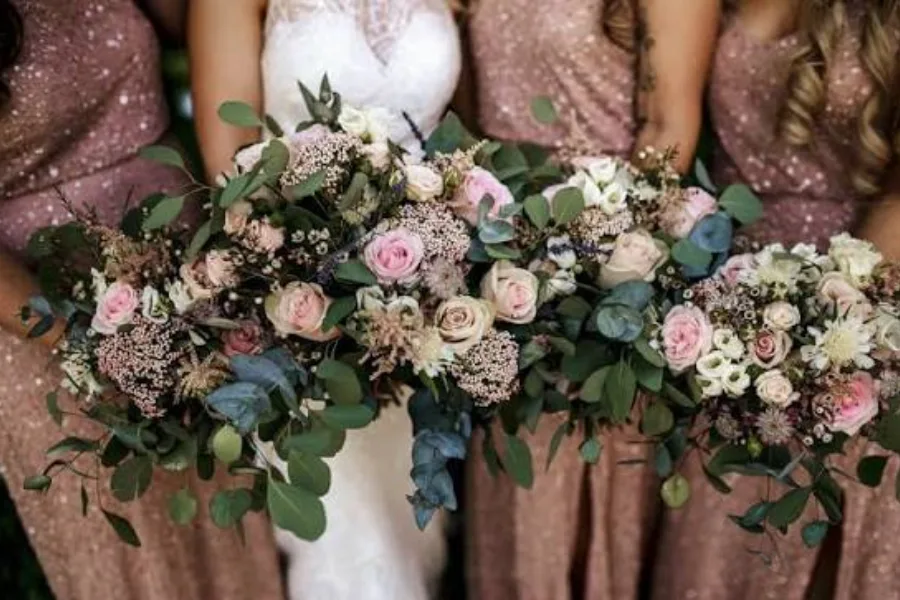
Floral Wedding Designers Madrid
Madrid is the only Spanish wedding market where scale genuinely matters, because the venues are built at a scale nowhere else is.
Palace and historic venues swallow arrangements. Ceilings of five or six metres, formal proportions and existing ornament mean anything designed for a normal room disappears. Madrid florists work with height, structure and repetition rather than volume: tall centrepieces on stands, columns of flowers, and pieces built vertically instead of spread across a table.
And the ornament competes. A gilded room already has visual weight, so restraint reads as confidence. Single-variety arrangements and disciplined palettes hold their own against baroque detail where abundant garden styling looks like clutter.
The climate is the opposite of the coast. Madrid sits at 650 metres and inland, so summers run hotter and drier than Marbella and winters are genuinely cold, with frost. That widens the calendar considerably: flowers that struggle on the coast in August struggle here too, but Madrid’s winter and shoulder seasons support blooms the south can’t sustain, and most weddings here happen in May, June, September and October anyway.
On supply, Madrid has the largest flower market in Spain, so availability and price are better than anywhere else in the country. Imported stems arrive here first before travelling south, which means the island premium and the coastal markup don’t apply.
Candlelight matters more than flowers indoors.
Floral Wedding Designers Ibiza
Ibiza is the hardest island in Spain to keep flowers alive on, and the styling that dominates here exists partly because of it.
Salt, sun and wind together are the problem. Clifftop and beach venues get all three, and delicate blooms don’t last an afternoon. That’s a large part of why the boho look took hold here: pampas, dried palm, bleached foliage and preserved textures don’t wilt, don’t need water, and can be installed the day before and look identical at midnight.
If you want fresh flowers, they need choosing for endurance rather than for the photograph you saved. Waxy varieties hold. Anything soft-petalled won’t. And the arrangement needs to be out of direct sun until the last possible moment.
Wind is the practical constraint on installations. Freestanding arches at clifftop venues need proper structural fixing rather than weighting, and anything suspended at a villa needs a fixing point that most Ibiza properties don’t have. Ask before you plan one.
On cost, everything imported arrives by boat or plane, so fresh stems carry an island premium on top of the usual markup. The local alternatives are olive, almond, wild grasses and rosemary, which grow here, cost a fraction, and suit the aesthetic anyway.
And the season is short. Ibiza florists work flat out from May to early October and the good ones are booked from winter. Book considerably earlier than you would on the mainland.
See our: Wedding venues in Ibiza
Ibiza
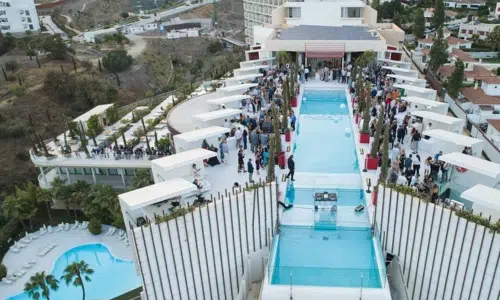
Gibraltar
Floral Wedding Designers Madrid
Gibraltar is small, and that shapes everything about flowers here.
The supplier pool is tiny. A handful of florists serve a population of 32,000 on a peninsula six kilometres long, so choice is limited and prices reflect it. Expect to pay noticeably more than you would twenty minutes across the border, for a narrower selection.
Which is why most couples bring flowers from Spain. Sotogrande is twenty minutes away and Marbella about an hour, both with far deeper florist markets and considerably better pricing. A Spanish florist can prepare everything the day before, drive it over and install on the morning, and the saving on a full wedding is usually several hundred euros at minimum.
The border is the thing to plan for. Cut flowers move freely for personal use, but the crossing can queue badly at peak times, particularly late morning and early evening in summer. A florist coming from Spain needs to build that into their timings rather than discover it on the day. Ask how they handle it, and whether they’ve done Gibraltar before.
Most couples don’t need much anyway. The majority who marry here do so at the Registry Office and hold the celebration in Spain afterwards, which means flowers for the legal ceremony are usually a bouquet, buttonholes and perhaps a small arrangement. Expect €200 to €500 for that, against €2,000 to €6,000 for a full wedding celebrated here.
If you are celebrating in Gibraltar, the venues are hotels, the Botanic Gardens and a handful of others, mostly compact and indoors. That suits structured arrangements over sprawling installations, and it means heat is less of a constraint than anywhere on the Spanish side.
And the wind is worth knowing about. The levante rolls off the Rock and can be fierce on the eastern side. Anything outdoors and freestanding needs proper fixing.
See our: Weddings in Gibraltar
Our Services

Venue Sourcing
Venue Sourcing & Tours | We expertly source and tour secure idyllic Andalucia wedding venues, from luxurious beachfront villas to rustic countryside fincas, perfectly tailored to your unique vision and style. See our hand selected Wedding Venues in Spain

Wedding Planning
Wedding Planning Services & Packages | Our professional Andalucia wedding planners meticulously handle every detail, from budgeting and guest logistics to design aesthetics, crafting personalised, stress-free celebrations. Also see our: Wedding Packages

On-Day Coordination
On-Day Wedding Coordination | Our dedicated on-the-day wedding coordinators ensure your Andalucia celebration flows seamlessly by managing timelines, vendors, and guest arrangements, so you can enjoy your special day.

Vendor Sourcing
Vendor Sourcing & Management | Leveraging our trusted network of premium local suppliers, from top caterers and talented DJs to photographers and florists, we seamlessly manage all vendor interactions.
Wedding Florists
We recommend reviewing our FAQs ahead of time to familiarise yourself with our services, pricing, and artistic approach, so your consultation can focus solely on creating a beautifully tailored, wedding experience.
If there’s something you’re unsure about, our friendly team is always just a call or email away. Please read our Frequestly Asked Questions / FAQs.
Contact Wedding Venues ES Today!
Discover your perfect wedding packages in Spain
Common Questions
How much do wedding flowers cost in Spain?
Most couples spend between €2,000 and €6,000 on flowers for a wedding of 80 to 100 guests, though it stretches considerably in both directions.
Roughly: a bridal bouquet €120 to €300, bridesmaids’ bouquets €50 to €90 each, buttonholes €12 to €25, table centrepieces €50 to €150, a ceremony arch €800 to €2,500, and a suspended installation €1,500 to €5,000.
Ask whether IVA at 21% is included, and whether setup and collection are in the quote or extra.
What pushes the price up most?
Flowers out of season, by some distance.
Expect two to three times the in-season price, sometimes more. Peonies are the clearest example: roughly €4 to €6 a stem in May, €15 or more in September if they can be sourced at all. Across a full wedding that’s thousands rather than hundreds.
The fix is straightforward. Give your florist your palette and your date rather than a list of flowers, and let them choose the varieties. Couples who specify exact blooms routinely pay double what those who specify colours pay, and nobody can tell the difference in a photograph.
Are flowers cheaper in Spain than at home?
No. Most are imported from Holland, Ecuador and Kenya, so you’re paying roughly European prices, plus a further premium on the islands.
Will they survive the heat?
Depends what you choose.
Hydrangeas wilt within hours on a July afternoon. Pale roses brown at the edges by the speeches. Waxy varieties, orchids and anthuriums hold far better, and dried elements don’t wilt at all, which is why boho styling took hold on the islands.
A florist who works here raises this before you do. If they don’t, they haven’t done many Spanish summers.
What can we reuse from the ceremony?
Almost everything. The arch becomes the backdrop behind the top table, the aisle arrangements move onto the dining tables during drinks, pedestals go to the entrance or the bar.
Agree it at the quote stage, because pieces need building with the move in mind and someone has to be there to do it.
How far ahead should we book?
Twelve months for a peak Saturday, earlier on Ibiza and Mallorca. Six to nine is fine midweek or off-season.
Venue first, then photographer, then florist. Your venue decides half the design.
Are delivery and collection included?
Delivery and setup usually are. Collection frequently isn’t, and that’s the most common gap between a quote and a final invoice.
Someone has to clear vases, stands and structures afterwards, often the morning after, and most venues charge if it isn’t done. Ask specifically whether it’s in the price, when it happens, and who’s responsible if hired vessels aren’t returned.
Can we supply our own flowers?
You can, and it usually costs more than couples expect.
Buying, conditioning, transporting and storing them takes a day you won’t have, and conditioning is most of what makes a professional bouquet last. Some venues won’t allow it either, and a florist installing your other pieces may decline to work around stems they haven’t prepared themselves.
Where do you offer floral design services?
We’re based in Marbella, so the Costa del Sol is home ground and we can often arrange coverage at short notice. Beyond that we work with florists across the whole of Spain and Gibraltar.
Andalucía: Marbella, Málaga, Estepona, Fuengirola, Benalmádena, Torremolinos, Mijas, Manilva, Sotogrande, Ronda, Cádiz, Tarifa, Seville and Granada.
The Balearics: Ibiza, Mallorca and Menorca.
Catalonia: Barcelona, Sitges, the Penedès and the Costa Brava.
Elsewhere: Madrid, Valencia, Alicante and the Canary Islands.
And Gibraltar, though most couples marrying there bring flowers over from Spain, which is cheaper and gives you far more choice.
Away from the Costa del Sol we’d rather use a florist who knows your venue than send someone from Marbella. Someone local knows the light, the access and what survives there, and it keeps travel off your quote.